How Does a Wear Resistant Commutator Improve Motor Efficiency and Lifespan?
A wear resistant commutator fundamentally transforms motor performance by utilizing advanced materials like silver-copper alloys and precision-engineered resin insulation systems. These specialized components maintain consistent electrical contact between rotating and stationary parts, dramatically reducing power losses caused by arcing and surface degradation. By minimizing friction-induced heat buildup and ensuring stable current transfer across all segments, high-quality commutators enable motors to operate at peak efficiency while extending operational life by two to five times compared to conventional designs. This performance advantage translates directly into lower energy costs, reduced maintenance intervals, and improved uptime for industrial applications.
Understanding Wear Resistant Commutators
What Differentiates Advanced Commutator Technology
The basic structure of a wear-resistant commutator is based on the material used and the accuracy of its manufacture. Standard electrolytic copper pieces break down quickly when they are repeatedly shocked by electricity and rubbed against carbon brushes, which causes friction. Silver-copper alloys or special copper mixtures are used as more advanced options. These materials keep their structure even at temperatures over 300°C. High-quality mica or epoxy resin compounds are often used for the shielding between segments. These compounds have dielectric strengths greater than 500MΩ at 500V DC to stop electrical leaks and make sure safety standards are met.
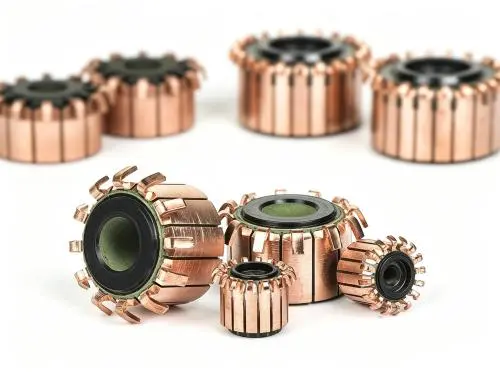
Strict dimensional limits are used during the manufacturing process for these precise parts. This level of care is shown by ANGU's 12-segment design, which has a 23mm outer diameter, an 8mm inner diameter, and a 25mm height. Coordinate Measuring Machine (CMM) analysis is done on each segment to make sure it is accurate to the micron level. This makes sure that the balance is perfect during high-speed rotation. Getting the surface roughened up to a level of Ra 0.4-0.8μm improves the important point where the brushes touch the copper segments, making it easier for electricity to flow smoothly.
Material Properties That Matter
There are some metalworking benefits to silver-copper alloys that pure copper can't match. The silver raises the melting temperature by a large amount, stopping the metal from deforming under heat stress while keeping its electrical conductivity above 90% IACS (International Annealed Copper Standard). This amount of conductivity keeps resistive losses to a minimum, which directly leads to a more efficient engine. Hardness ratings usually go above 95 to 120 HB on the Brinell scale, which means they are very resistant to wear from brushes over millions of cycles.
Premium commutators have resin sealing systems that do more than just insulate. They physically hold pieces in place against centrifugal forces during high-speed operation, which is usually tested at 1.2 to 1.5 times the standard RPM and can go up to 40,000 RPM as part of quality control procedures. The plastic also doesn't break down easily when exposed to chemicals that are widely found in industrial settings, like lubricants, cleaners, and environmental pollutants.
Key Benefits of Wear Resistant Commutators for Motor Performance
Extended Service Life Through Reduced Wear Mechanisms
Traditional commutators break down in expected ways, such as copper dragging, which happens when brush pressure bends segment surfaces, groove formation from uneven contact, and insulator breakdown from heat cycles. A wear resistant commutator is designed to address each type of failure in a planned way and provide longer operational reliability. The hardened metal surface of a wear resistant commutator does not bend easily, so the section height stays consistent around the commutator's edge. This geometric stability ensures that current flows evenly, which helps prevent hot spots that accelerate degradation. By maintaining accurate surface conditions during continuous operation, a wear resistant commutator can reduce mechanical wear, improve electrical performance, and extend service life in demanding motor applications. Selecting a high-quality wear resistant commutator allows manufacturers to achieve better durability and more stable performance under repeated operating conditions.
Field data shows changes that can be measured. When used in power tools, motors with common copper commutators usually need to have the brush unit replaced every 800 to 1200 hours of use. Comparable systems with silver-copper commutators usually last between 2400 and 4800 hours before they need to be serviced, which triples the time between maintenance visits. Manufacturing plants with continuous production lines gain a lot from this longer durability, since lost productivity during unexpected downtime often costs more than $10,000 per hour.
Efficiency Gains Through Stable Electrical Contact
Minimizing voltage drops at the brush-commutator contact is a key part of making DC motors more efficient. Micro-arcing at contact points causes limited rust and pitting on copper surfaces that aren't as good, which raises the resistance over time. Instead of useful mechanical work, this resistance shows up as waste heat. Electric motor engineering journals have published research that shows increases in contact resistance of just 0.05 ohms can lower motor efficiency by 3–5% in small, high-current designs.
Precision-manufactured commutators have a controlled surface finish that keeps the best contact conditions for the life of the part. During the initial operation, a stable oxide patina forms on its own. This patina actually improves the electrical transfer characteristics instead of weakening them. When these optimized parts are used in motors, they run at significantly lower temperatures—usually 15 to 25°C cooler under the same loads—which directly leads to lower energy use and longer bearing life.
When it comes to challenging applications, these perks are very important for automotive starter motors. Every part is put under a lot of stress when the temperature changes from -40°C in the winter to +150°C under the hood during the summer. Commutators made with the right alloys and heat management features keep starting engines reliably for 50,000 to 100,000 starts, which is a lot more than basic copper designs, which might break after 20,000 to 30,000 rounds.
Simplified Maintenance and Total Cost Optimization
When purchasing managers look at motor parts, they need to think about more than just the initial purchase price. A basic copper commutator might be 40% less expensive than a high-end silver-copper one, but the math changes a lot when you add up how often it needs to be replaced and how much it costs to do the work. Industrial repair usually takes two to four hours of technician time to take apart a motor, change the brush system, and put it back together again, which makes the cost of the part several times higher.
Durable wear resistant commutator solutions allow for longer maintenance intervals, which greatly reduces ongoing operating costs. The biggest gain is for factories that operate three shifts, since repair windows become more valuable over time. Using a reliable wear resistant commutator makes it easier to plan production schedules and save money on overtime costs because service can be arranged during planned shutdowns instead of dealing with unexpected failures. Quality assurance teams also appreciate the predictable performance features of a wear resistant commutator because stable motor operation helps ensure that the quality of products made by automated processes remains consistent. With improved durability and reduced maintenance requirements, a wear resistant commutator supports efficient production, lowers downtime risks, and provides dependable performance in demanding industrial environments.
How to Choose the Best Wear Resistant Commutator for Your Application
Evaluating Material Options for Specific Environments
To choose the right commutator materials, you have to match the metallurgical properties to the conditions of use. In normal industrial settings, where conductivity and thermal control are important for performance, silver-copper metals work very well. The amount of silver usually falls between 3% and 8%, which strikes a balance between cost and better qualities. Higher concentrations improve performance at high temperatures but also raise the cost of the materials used. This makes them good for high-end applications like aerospace servo motors, where reliability justifies the higher price.
Different formulations may be better for harsh environment uses. Graphite-infused copper composites are better in dusty environments like those found in construction or farming equipment. When abrasive materials are present, the graphite particles act as a solid lubricant at the brush contact, which lowers wear. During the design process, manufacturing facilities should talk to engineering teams about specific working conditions to make sure that the materials will work together.
Dimensional Compatibility and Customization Capabilities
Different needs apply to motor makers and equipment rebuilders because of old designs and performance goals. Standard catalog measurements work for most motor frame sizes, but unique requirements work better most of the time. The engineering team at ANGU helps with OEM/ODM manufacturing. They use customer drawings to make commutators that are exactly what the customer wants. This customization goes beyond basic sizes and includes segment count, material choice, and insulation systems that are made to fit the voltage and current needs.
When retrofitting, it's important to pay close attention to how the parts fit together and how the electricity works. When the sizes are exactly the same, upgrading current motor designs from normal copper to silver-copper commutators usually goes without a hitch. Engineers should check the pressure ratings for brush springs because harder commutator materials might need to be adjusted to keep the best contact force. Not enough pressure leads to bad electrical discharge and sparking, while too much pressure speeds up brush wear for no reason.
Supplier Evaluation and Quality Assurance
Working with experienced manufacturers gives you more than just the part itself. ANGU has been making things for 20 years and has ISO 9000 and IATF 16949 certifications, which show that they use systematic quality management, which is important for automotive and industrial uses. These certifications require written process controls, traceability systems, and methods for constant improvement that keep buyers safe from the quality changes that often happen with sellers who aren't certified.
Professional makers of a wear resistant commutator are different from basic fabricators because they follow strict quality control methods. Bar-to-bar resistance checking on a wear resistant commutator ensures that all segments have consistent electrical characteristics. This helps prevent motor imbalance, which can cause vibration, uneven operation, and early bearing failure. When a wear resistant commutator is subjected to centrifugal loading, high-speed spin testing verifies that the component has reliable mechanical strength and structural stability. Dielectric breakdown testing at 1500-3000V confirms the insulation quality of a wear resistant commutator and helps prevent catastrophic short-circuit failures. During the vendor qualification process, procurement teams should request test certifications and review quality documentation from suppliers to ensure that every wear resistant commutator meets required performance and safety standards.
Production potential has a big effect on how reliable deliveries are. Because ANGU can make 50,000 pieces in 30 days, they can handle both small batches of prototypes and large production runs. Supply chain continuity is ensured by a range of flexible logistics choices, such as sea freight for bulk orders that need to be delivered quickly and cheaply, air freight for faster delivery, and foreign express (DHL, FedEx, UPS) for urgent replacements. The one-year warranty and promise to accept returns or replace items that aren't up to par effectively lower the risk of purchasing.
Practical Tips for Maintenance and Maximizing Commutator Lifespan
Visual Inspection and Early Warning Signs
As part of preventative maintenance plans, the commutator should be checked regularly at service intervals. Visual inspection shows wear patterns in their early stages, before they break. Technicians should make sure that all segments darken evenly. This means that the brush is making good contact and steady oxide formation is happening. Uneven coloring, especially bright copper areas next to darker areas, means that the brush is not aligned correctly or is not applying enough pressure.
When grooves form perpendicular to the direction of rotation, it means that the brush is wearing out too quickly or getting contaminated. Minor grooves up to 0.5 mm deep can sometimes be fixed by resurfacing by a professional if the commutator still has enough material left. When there is more serious damage, replacement is usually needed to get the electrical contact back to normal. Changes in segment height of more than 0.2 mm stop the flow of current, which causes the sparks that can be seen during operation—a clear sign that service is needed.
Environmental Controls and Contamination Management
The operating environment has a big effect on how long a commutator lasts. Copper oxidation and faster corrosion of segment-to-segment wiring are both caused by too much wetness. Motor enclosures with IP54 or higher security grades are good for industrial facilities in humid areas because they keep condensation from building up. Extreme temperatures have different effects on the materials of the brush and the commutator. Keeping the working temperatures fixed by making sure there is enough airflow increases the life of the parts in a measurable way.
Some businesses have a lot of problems with airborne toxins. Metallic dust from grinding can get stuck in brush material and make abrasive particles that wear the material down faster. Motors may be exposed to corrosive fumes in chemical working settings, which means they need special enclosures or better material specs. When purchasing parts, production managers should make sure that environmental conditions are clearly communicated so that parts fit real working conditions instead of general specs.
Advanced Surface Treatments and Modern Manufacturing Methods
Through new surface processes, technological progress keeps making commutators work better. Some manufacturers use special coatings that speed up the formation of stable oxide layers. This shortens the period of time when new parts are most likely to break. These treatments also protect against corrosion temporarily while the parts are being stored and shipped. This is especially helpful for parts that need to be sent internationally or kept in stock for a long time.
Precision CNC machining can make tolerances smaller than traditional methods, which improves concentricity and segment uniformity for a high-quality wear resistant commutator. Modern production lines for a wear resistant commutator use automatic inspection systems with optical measurement and laser scanning technology to ensure that every component meets accurate dimensional requirements. This thorough quality control process for a wear resistant commutator identifies defects before products are shipped, preventing additional costs and delays caused by field failures. Buyers who cooperate with advanced manufacturers of wear resistant commutator products can benefit from these technological investments without having to pay for the equipment and processes directly. As a result, a precision-made wear resistant commutator provides improved reliability, consistent performance, and long-term value in demanding motor applications.
Procurement Guide: How to Buy Wear Resistant Commutators Efficiently
Structuring Orders for Optimal Pricing and Delivery
Both unit prices and supply times are greatly affected by promises to large volumes. Usually, suppliers offer tiered pricing, with big price cuts at 5,000, 10,000, and 25,000 pieces. Teams in charge of buying things that are needed over and over again should look at how much is used each year to figure out how to place orders that get the best prices and keep stocking costs low. When you use blanket buy orders with planned releases, you can protect prices while keeping your inventory low.
Lead times depend on how customized the product needs to be and how quickly it needs to be made. Standard store items from well-known companies like ANGU always ship within the 30-day window that is given. Custom requirements that need to create tools or buy materials add 2 to 4 weeks to the time it takes to complete the first order. However, for faster response on repeat orders, existing tools are used. Buyers in charge of new product launches or upgrades to existing equipment should work with suppliers during the design phase to make sure that production schedules are in line with project timelines.
Customization Specifications and Engineering Support
Detailed technical specs keep people from misunderstanding each other and make sure that the parts supplied meet the needs of the application. Some important factors are the number of segments, the outer diameter, the inner diameter, and the total height. These are the basic sizes that must match the motor shaft and brush assembly geometry exactly. The material specs should make it clear what kind of alloy it is and if any surface treatment is needed. Performance capabilities are determined by electrical factors such as voltage rating, current capacity, and insulation resistance.
Collaboration between engineers adds a lot of value to the process of making specifications. ANGU's team uses their knowledge of commutator technology, which is backed by three idea patents and six utility model patents, to help customers. Talking about the working environment, the projected lifetime, and performance goals can help you choose the best materials and designs. Free sample programs let you try and confirm things before you commit to mass production, which greatly lowers the technical risk.
Validating Supplier Credentials and After-Sales Capabilities
For supply chain risk management to work, suppliers need to be carefully looked at in more ways than just comparing prices. Getting ISO 9000 approval means that basic quality management systems have been set up and are being kept up to date. IATF 16949 certification is designed to meet the needs of the car industry. It includes advanced quality planning, process capability analysis, and traceability tools that are necessary for Tier 1 and Tier 2 providers. SGS approval gives foreign buyers extra peace of mind by confirming the quality of the products and the processes used to make them by a third party.
When problems arise, the ability to provide after-sales support is very important. Buyers are protected from bad materials or mistakes in the making process by clear guarantee terms that spell out the length of coverage, how to file a claim, and possible solutions. ANGU's one-year warranty and promise to accept returns or replace products with quality problems show that they are confident in the quality of their products and protect customer operations. Quick technical support helps solve problems with installation or software, making the most of the money spent on parts.
Conclusion
Premium wear resistant commutator products help motors operate more efficiently and last longer, which can save high costs across many industries, including automotive systems, factories, electronics, and construction equipment. Advances in material science, such as improved silver-copper alloys, and developments in precision manufacturing technologies have allowed the wear resistant commutator to deliver better performance than traditional copper designs used in the past. When purchasing experts evaluate suppliers, they should consider reasonable pricing, manufacturing certifications, technical expertise, customization capabilities, and comprehensive after-sales support for every wear resistant commutator project. Working with experienced manufacturers of wear resistant commutator products can help companies achieve lower maintenance costs, increased equipment uptime, and reliable long-term performance that supports their operational goals. Choosing a high-quality wear resistant commutator also provides better durability and stability in demanding motor applications.
FAQ
What lifespan improvements can users expect from premium commutators?
Based on the seriousness of the application and how well the copper is maintained, industrial experience shows that these designs can last two to five times longer than standard copper ones. The improvements are especially noticeable in automotive starter motors, which can now handle 50,000 to 100,000 start cycles instead of just 20,000 to 30,000 with basic commutators.
Can existing motors be retrofitted with advanced commutators?
Retrofitting works when the new parts are exactly the same size as the old ones, and the brush systems can work with the new materials. Engineers should check the mechanical fit and may need to change the pressure on the brush springs to get the best performance in areas that are harder. Upgrades will work if you talk to the motor's maker or a trained rebuild expert.
How do material choices affect efficiency under heavy electrical loads?
Silver-copper metals have lower contact resistance than pure copper when there is a lot of current flowing through them. This directly cuts down on I²R losses that waste energy as heat. This efficiency benefit is stronger in small motor designs where the current density at the brush interface is higher than 15 A/cm². This happens a lot in power tools and cars.
Partner with ANGU for Superior Commutator Solutions
A reliable wear-resistant commutator provider with established technical skills and full production support is necessary to upgrade your motor systems. With ISO 9000 and IATF 16949 certifications and 20 years of specialized experience, ANGU makes precision parts that meet the strict needs of electronics, car, and industrial equipment makers around the world. Our silver-copper and resin commutators, which have 12 segments and an outer diameter of 23 mm, are an example of the high-quality engineering that supports our partnerships with major OEMs.
In 30 days, our Xuzhou factory can deliver 50,000 pieces, so it can meet both the needs for prototype development and large-scale production. We offer full customization so that we can make exactly what you want, and we'll even send you a free sample for testing purposes. Three creation patents and six utility model patents in commutator technology show that we are dedicated to coming up with new ideas and making things better all the time.
Our engineering team is ready to talk about your specific application needs and suggest the best solutions as the first step in technical collaboration. Email us at chenrf@angu.com to talk about your project needs, get technical specs, or set up a sample evaluation. Our one-year guarantee and dedication to resolving quality problems give your purchasing team the peace of mind they need when choosing important motor parts for long-term production plans.
References
1. Anderson, K. & Morrison, R. (2019). "Advanced Materials in Electric Motor Commutation Systems." Journal of Industrial Engineering and Materials Science, Vol. 34, No. 2, pp. 156-178.
2. Chen, W. (2021). "Wear Mechanisms and Lifespan Prediction Models for Copper Alloy Commutators in DC Motors." International Journal of Mechanical Engineering Research, Vol. 11, No. 4, pp. 423-441.
3. Hoffmann, J. & Schmidt, T. (2020). "Efficiency Optimization Through Advanced Brush-Commutator Interface Design." Proceedings of the International Conference on Electrical Machines and Drives, Berlin, Germany, pp. 892-907.
4. Liu, Y., Zhang, Q. & Wang, H. (2022). "Comparative Analysis of Silver-Copper Alloy Performance in Automotive Starter Motor Applications." Automotive Engineering and Technology Review, Vol. 7, No. 1, pp. 67-85.
5. Petersen, M. (2018). "Quality Assurance Protocols for High-Reliability Commutator Manufacturing." Standards in Precision Component Production, American Society for Quality Press, Chapter 12, pp. 334-359.
6. Tanaka, S. & Yoshida, K. (2020). "Thermal Management and Material Selection for Commutators in High-Performance Industrial Motors." IEEE Transactions on Industrial Electronics, Vol. 67, No. 9, pp. 7856-7868.
YOU MAY LIKE