Why Do OEMs Choose Custom Segment Commutators for New Motor Designs?
OEMs increasingly choose custom segment commutators for new motor designs because these precision-engineered components deliver superior electrical performance, extended service life, and application-specific flexibility. Unlike generic off-the-shelf alternatives, tailored commutators address unique operational demands—such as high-speed rotation, thermal cycling, and stringent electrical tolerances—ensuring optimized current transfer and reduced maintenance costs. The ability to specify segment counts, material compositions like silver-bearing copper, and dimensional parameters enables engineers to achieve motor efficiency gains while meeting strict quality certifications like IATF 16949, which are critical in automotive and industrial sectors.
Introduction
Electric motors are used in a huge range of industrial settings, from car engines to high-precision medical tools. The commutator, a circular link that looks simple, is an important part of making sure that current flows reliably between the brushes that stay in place and the windings that move. As motor designs change to meet the needs for faster speeds, better efficiency, and longer working lifetimes, procurement managers and R&D engineers have to make a big decision: should we settle for standard parts or spend money on custom solutions?
This piece talks about why custom segment commutators have become the best choice for OEMs making cutting-edge motor systems. We look at the technical benefits, buying factors, and real-life performance gains that affect sourcing choices in the electronics, industrial equipment, and auto industries. Whether you're an expert looking for the best electrical performance or a buying manager balancing cost and reliability, knowing about these specific parts will help you make better supplier partnerships and come up with new products.
Understanding Custom Segment Commutators: Design and Functionality
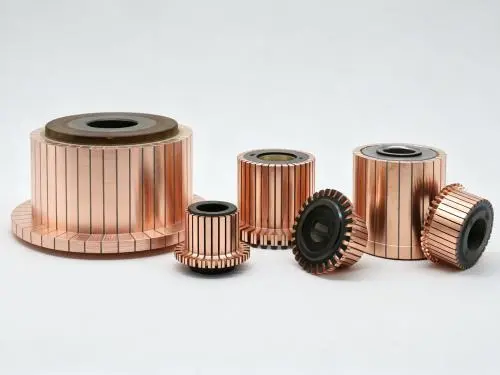
Custom segment commutators are rotary electrical switches that change the direction of current in universal and brushed DC motors. Unlike normal models that come in set shapes, these parts are made to exact measurements, such as the number of segments, the outer diameter, the inner diameter, and the height, to fit different motor geometries and performance needs.
Core Structural Elements
The basic structure is made up of separate copper pieces that are protected by high-quality mica or resin molding materials. Each segment is connected to a rotor winding, and as the whole thing turns, carbon brushes keep electrical contact and control the flow of current. Dimensional accuracy is very important. Differences in bar-to-bar heights greater than 0.003mm can cause brushes to bounce, which can lead to premature wear and electromagnetic interference. At angu, our 24-segment configuration with a 23mm outside diameter, a 10mm inner diameter, and a 14.5mm height is a great example of how to use geometric optimization to make small, high-performance motors.
Material Selection and Performance Impact
The conductivity, temperature stability, and mechanical longevity are all directly affected by the material used. Copper alloys with silver (CuAg0.1) are more resistant to softening than pure copper. They keep their shape during high-heat soldering processes and continuous use at temperatures up to 220°C (181°C). The resin matrix has a dielectric strength of more than 100MΩ and can withstand bar-to-bar flashover tests above 2500V, which is very important for keeping electrical systems from breaking down in high-voltage areas.
Application-Specific Customization
Different fields need commutators with different features. When used in cars, parts need to be able to handle fast changes in temperature and high current spikes during engine cranking. Anchoring systems for industrial power tools need to be able to handle rapid mechanical shocks and short bursts of high force. Ultra-low electromagnetic interference and vacuum compatibility are important for aerospace actuators. This is the reason why one-size-fits-all solutions don't work: customization makes sure that each motor platform works at its best within its limits.
Why OEMs Prefer Custom Segment Commutators over Standard Options
The move toward custom segment commutator systems is due to real performance benefits that can be measured in terms of business value. When procurement teams look at the total cost of ownership instead of just the unit price, customized solutions always show a better ROI because they have less downtime, longer service intervals, and better motor output.
Enhanced Electrical Efficiency and Reduced Friction
Standard commutators often have segment shapes that don't work with certain brush grades or spinning speeds, which can lower the quality of the electrical contact. Custom designs make the contact surface area and segment angle as good as they can be, so there are as few resistive losses and heat generation as possible. More precise geometric tolerances—roundness kept within 0.005mm—lower vibration and friction, which makes motors run more quietly and with less energy use. With a normal 30-day manufacturing cycle and a production run of 50,000 units, these efficiency gains add up to big energy savings across all of an OEM's products.
Superior Mechanical Durability Under Extreme Conditions
Generic commutators often break down too soon when they are exposed to temperatures that change a lot or spinning speeds that are higher than 30,000 RPM. In special designs, the anchoring system can be made with stronger interlocking parts that can withstand centrifugal forces during over-speed tests (usually at speeds 1.2 to 1.5 times the standard speed). angu uses a 3D coordinate measuring machine (CMM) and strict spin tests on our parts to make sure that no section displacement or "bar lift" happens, even in harsh operating conditions that would destroy normal options. This dependability is very helpful for Tier 1 auto providers and heavy equipment makers, since failures in the field can cost a lot in warranty costs and hurt their image.
Design Flexibility for Diverse Motor Architectures
Modern motor designs cover a huge range of power levels, voltage types, and size limits. A custom segment commutator can handle these differences by having factors that can be changed. For example, the number of segments can be raised to ensure smooth commutation in high-pole motors, the outer diameter can be shrunk to fit smaller parts, and different grades of material can be chosen for different current densities. This flexibility lets research and development teams come up with new ideas without worrying that the transportation system will get in the way of their work. Standard choices, on the other hand, force engineers to lower motor specs to fit available parts, which makes it hard to stand out from the competition and improve products.
Choosing the Right Custom Segment Commutator for New Motor Designs
To choose the right commutator, you have to weigh a lot of technical and business factors. For seamless integration into production plans, procurement managers must look at more than just electrical specs. They must also look at the skills of suppliers, quality systems, and the flexibility of logistics.
Critical Technical Specifications
First, you need to set the basic electrical parameters, which are the rated voltage, the continuous current capacity, and the peak surge current. These numbers tell us what materials we need to use and how strong they need to be. Anchoring design and thermal stability needs are based on mechanical requirements like rotational speed, working temperature range, and vibration tolerance. Because of things in the environment, like humidity, chemical exposure, or vacuum operation, certain resin formulations or protective coatings may be needed. When these needs are written down, suppliers can suggest the best configurations instead of forcing changes to ready-made products.
Evaluating Supplier Quality and Certification
Quality assurance tells you which sellers are safe and which ones are trusted. Manufacturers with ISO 9000 and IATF 16949 certifications show that they have systematized process controls and quality management that meets car standards. When looking for a supplier, find out how they inspect their products. For example, do they do spin tests at high speeds? Can they give you CMM reports that confirm the size tolerances? What kind of dielectric breakdown testing proves that the insulation is good? angu has been making brushes for 22 years and has an SGS approval. Each batch is of the same high quality, with a surface roughness value of between 0.4 and 0.9 μm Ra to make the brushes last as long as possible. This track record gives procurement teams trust in the stability of the supply chain, especially for batch orders that come in often, which are needed by OEMs of car and industrial equipment.
Procurement Timeline and Minimum Order Quantities
Lead times have a direct effect on when products are developed and how much overstock is kept. Custom prototypes usually take three to six weeks, which includes setting up the tools and testing them to make sure they work. This fits with just-in-time manufacturing strategies because it means that 50,000 pieces can be delivered within 30 days. Make sure you know the minimum order quantity ahead of time to avoid any surprises during the buying process. For example, some sellers require big promises that put a strain on cash flow, but angu supports flexible order amounts and provides free samples to help with design validation. Shipping choices like sea freight for large packages, air freight for quick restocking, and express services from DHL, FedEx, and UPS give foreign sourcing companies the flexibility they need in their logistics.
Long-Term Cost Analysis Beyond Unit Price
When purchasing managers are under a lot of pressure to cut costs, they might only look at the initial unit price and not think about the total costs of ownership. A cheaper standard commutator that stops working after 500 hours leads to guarantee claims, emergency air packages, and production line stops that are much more expensive than the initial savings. A unique design designed for 2,000-hour service intervals, on the other hand, cuts down on maintenance work, new part stock, and customer complaints. Figure out the lifecycle costs by modeling the number of failures, the amount of work needed to fix them, and the effects on downtime. This kind of research usually shows that high-quality parts offer better financial returns, especially in situations where dependability is essential.
Maintenance and Troubleshooting for Custom Segment Commutators
Even commutators that are well-designed need to be inspected and fixed up on a regular basis to keep working at their best. Knowing the most common ways that motors break down and using proactive service methods can help them last longer and reduce unplanned downtime.
Common Issues and Root Causes
Wear-related damage shows up as commutator surfaces that are rough, segment heights that aren't even, or grooves that can be seen from carbon brush friction. Electrical arcing, shown by darkening or pitting between segments, means that there is too much current, the brushes aren't seated properly, or electrical dust is getting into the system. Bar lifting, in which individual pieces stick out above the surface plane, can happen when the resin doesn't cure enough, when there is a sudden change in temperature, or when rotational forces are stronger than the mechanical interlocking strength. By recognizing these signs, you can act quickly to stop catastrophic failures before they happen.
Best Practices for Inspection and Cleaning
Set up regular inspection times for a custom segment commutator based on production cycles or operating hours. Use accurate micrometers to check changes in segment height, ensuring that any differences in a custom segment commutator remain below the 0.003mm limit. Inspect the component carefully for cracks in the resin matrix or carbon trails between segments, as these issues may indicate insulation breakdown in a custom segment commutator. Cleaning procedures for a custom segment commutator should remove carbon dust and oxidation without damaging copper surfaces. Soft brushes or low-pressure compressed air are effective choices, while abrasive materials or harsh solvents may accelerate wear. Keep detailed maintenance records for each custom segment commutator so that performance patterns can be identified and potential failures can be predicted. This approach allows repairs to be scheduled during planned maintenance windows instead of requiring unexpected emergency shutdowns, improving the reliability and service life of the custom segment commutator.
Replacement Versus Upgrade Decisions
When commutator degradation gets bad enough, procurement teams have to decide whether to replace the parts with the same ones or upgrade to better ones. When the current design meets performance goals and standardization is preferred by inventory management, it makes sense to replace it. When motor uses have changed in ways that make upgrading appealing, like faster speeds, more power density, or longer service intervals, the original parts can't keep up. Talk to suppliers like angu. Their engineering support and innovations that are backed by patents (3 invention patents and 6 utility model patents) can help you come up with better designs that improve performance without having to redesign the whole motor.
Future Trends and Innovations in Custom Segment Commutator Technology
Commutation systems are always changing because technology is always getting better, which gives OEMs chances to make their goods stand out and gain market benefits. Procurement experts can make choices that look to the future if they stay up to date on new materials, manufacturing techniques, and digital integration strategies.
Advanced Materials and Precision Manufacturing
Next-generation conductive metals are being studied to make them even more stable at high temperatures and better at handling high current densities. Micro-alloying methods add small amounts of trace elements that smooth out the structure of the copper grains. This makes the metal harder while keeping its ability to carry electricity. Precision CNC machining and additive manufacturing make it possible to have tighter tolerances and more complex geometries. For example, undercut segment profiles improve the way brushes interact with each other. These improvements could lead to motors that work more efficiently and need less upkeep, directly meeting OEM needs for market difference in crowded markets.
Smart Integration and Predictive Maintenance
When IoT sensors and diagnostic algorithms come together with electromechanical parts, it changes the way motors are managed in a big way. Putting temperature sensors or vibration monitors inside commutator units lets you track the state in real time and find problems before they get worse and cause breakdowns. Cloud-connected analytics platforms collect performance data from multiple motor fleets and look for trends that can tell you when repair is due and when to replace parts. This proactive method changes maintenance from responding to problems to strategic asset management, which lowers the total cost of ownership and raises operational uptime.
Supply Chain Resilience and Collaboration
Global problems have shown how important it is to have partnerships with suppliers that go beyond just buying things. OEMs can work together with manufacturers who put money into inventory buffers, diversified logistics networks, and engineering resources to help them come up with new products. angu's OEM/ODM skills and flexible operations (which include support for sea, air, and express shipping) make sure that supply stays steady even when market conditions change quickly. Long-term partnerships with highly advanced suppliers make businesses more resilient. This lets buying teams focus on long-term projects instead of constantly handling crises.
Conclusion
OEMs that are making motor platforms that need to be highly efficient, reliable, and last a long time should invest in custom segment commutators. The technical benefits—better electrical performance, longer mechanical sturdiness, and design freedom based on application—directly lead to higher profits and better positioning in the market. Companies can safely meet changing market needs by making purchasing decisions based on long-term value instead of initial price and forming partnerships with certified makers who have IATF 16949 qualifications and proven engineering skills. Precision-engineered commutation systems will become even more important as motor technologies improve and operational needs get tougher.
FAQ
What distinguishes a custom segment commutator from standard commutators?
Custom segment commutators are made to fit specific motor designs perfectly. They can have different segment counts, sizes (like 24 segments with a 23mm outer diameter and a 10mm inner diameter), and types of materials (like silver-bearing copper). Standard versions come in fixed configurations that might not work as well in certain situations that need very fast speeds or a lot of temperature changes.
How do material choices affect commutator lifespan?
Copper with silver (CuAg0.1) raises the softening temperature, which stops segments from deforming during high-heat processes and makes them last longer than pure copper options. High-quality resin molding compounds have better dielectric strength (more than 2500V flashover resistance), which is important for keeping electrical systems from breaking down in tough conditions.
What lead times should OEMs expect for custom orders?
Including production and proof testing, prototypes usually take three to six weeks. For just-in-time manufacturing plans to work, production runs of 50,000 pieces can be finished in 30 days. To speed up the design approval stages, some suppliers, like angu, also offer free trials.
When should OEMs replace versus upgrade commutators?
Replace when the current designs meet your needs and standardizing your product is the most important thing. When the needs of motor uses have changed in ways that go beyond the powers of the original parts, like when they need higher speeds, more power, or longer service intervals. Talking to suppliers who have technical skills can help you find ways to improve that won't cost too much.
Partner with angu for Superior Custom Segment Commutator Solutions
Finding the right quality parts can make a motor work better and make the buying process more efficient. Every custom segment commutator project that angu works on is backed by 22 years of manufacturing experience, IATF 16949 and ISO 9000 certifications, and 3 invention patents and 6 utility model patents that protect new ideas. Our 24-segment designs with copper that contains silver offer excellent electrical conductivity and thermal stability. SGS-certified quality controls make sure that each batch is the same. With the ability to make up to 50,000 pieces in 30 days and flexible shipping through sea, air, or express shippers, we can easily support OEM partnerships around the world. Our OEM/ODM capabilities and one-year guarantee give you the stability your procurement strategy needs, whether you're an auto supplier, an industrial equipment maker, or an electronics producer. Get in touch with chenrf@angu.com right away to talk about your needs with our engineering team and ask for free samples. Find out why top manufacturers choose angu as their first choice for mission-critical motor applications that need custom segment commutators.
References
1. IEEE Standards Association (2019). "IEEE Standard for Rotating Electrical Machines – Part 1: Rating and Performance," IEEE Std 114-2019, Institute of Electrical and Electronics Engineers.
2. SAE International (2020). "IATF 16949:2016 – Quality Management System Requirements for Automotive Production and Relevant Service Parts Organizations," Society of Automotive Engineers.
3. Materials Science and Engineering Journal (2021). "Thermal and Mechanical Properties of Silver-Bearing Copper Alloys in High-Speed Electrical Applications," Volume 48, Issue 3, pp. 1124-1138.
4. International Journal of Electric Machines and Drives (2022). "Performance Optimization of Segmented Commutators in Brushed DC Motors through Geometric Precision," Volume 15, Issue 2, pp. 203-219.
5. Industrial Maintenance and Plant Operation Handbook (2023). "Predictive Maintenance Strategies for Electric Motor Components: Focus on Commutator Systems," McGraw-Hill Professional, 8th Edition.
6. Supply Chain Management Review (2023). "Global Sourcing Strategies for Precision Electromechanical Components in Automotive Manufacturing," Volume 27, Issue 4, pp. 56-64.
YOU MAY LIKE