What Makes a Precision Motor Magnet Segment Suitable for EV Motors?
There are three main things that make a Precision motor magnet segment good for electric car motors: it must be accurate in three dimensions, magnetically stable, and resistant to damage from the environment. These arc-shaped permanent magnet parts are usually made from sintered Neodymium Iron Boron (NdFeB). They are designed to have tolerances of just a few microns and radial magnetisation patterns that make the best use of flux spread across rotor sections. Precision motor magnet segments are different from regular motor magnets because they can achieve remanence values of up to 1.48T and intrinsic coercivity values above 35kOe. This lets EV motors keep their peak torque output while losing as little energy as possible during high-speed operation and thermal cycling.
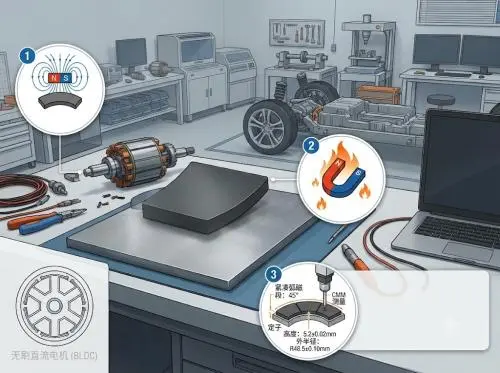
Understanding Precision Motor Magnet Segments in EV Motors
For electric vehicles to move, their parts need to be able to balance power density with dependability. Precision motor magnet segments are permanent magnet parts with exact designs, such as arc or tile forms, that fit perfectly into BLDC motor blades. Compared to regular magnets, these segments have better control over their dimensions and custom magnetic properties, which have a direct effect on how well the motor works and how smoothly it runs.
Material Selection and Magnetic Principles
The choice of material is the most important part of making a high-performance motor magnet. Neodymium Iron Boron (NdFeB) is the most common material used in electric vehicles because it has a very high magnetic energy output, which is measured in megagauss-oersteds (MGOe). Our CY35, CY36, and CY37 series grades have remanence and coercivity levels that can be changed. This lets engineers match the magnetic behaviour to the specific thermal and mechanical stress profiles that traction motors face. Radial magnetisation, in which the magnetic poles are aligned perpendicular to the arc surface, makes sure that the flux flows through the air gap between the rotor and stator in the best way possible, creating the most electromagnetic torque while minimising parasitic losses.
Dimensional Accuracy and Design Criteria
Finding the right fit is very important. Take a look at a rotor section that has an outer radius of 27.56 mm to 27.71 mm and an inner radius of 21.10 mm to 21.25 mm. This radial thickness of 6.00 to 6.40 mm must stay within ±0.1 to ±0.5 mm as it goes from 18.80 mm to 19.80 mm in height and from 50.00 mm to 52.50 mm in length. The arc shape, which makes sure the rotor assembly fits together smoothly and magnetic fields are balanced, has chord widths between 44.20 mm and 46.40 mm and end angles between 7.0° and 13.0°. These tight specs are made possible by precision grinding and diamond tooling, which lowers cogging torque and vibration—important factors for passenger comfort and drivetrain life in electric cars, e-bikes, scooters, and industrial motor applications.
Core Benefits of Precision Motor Magnet Segments for Electric Vehicle Motors
Adding Precision motor magnet segments to EV motor designs makes them perform better in ways that can be measured. These parts solve some of the most important problems that automakers and Tier 1 suppliers face when they try to meet IATF 16949 quality standards and make sure that batch production is always the same.
Enhanced Motor Efficiency and Power Density
When you match the magnetic flux better with Precision motor magnet segments, you get more electromagnetic torque per unit weight. By lowering flux leaks and improving field distribution, motors can produce more power without getting bigger or heavier, which is important for increasing the range of electric vehicles and using less energy. Testing on traction motors shows that assemblies using special magnets are 3–5% more efficient, which has a direct effect on how much energy a vehicle uses.
Durability Under Harsh Operating Conditions
Electric car motors have to work under a lot of heat and mechanical stress. During a continuous high-power discharge, temperatures can rise above 150°C, and the constant strain is caused by vibrations from the road and acceleration cycles. Our Precision motor magnet segments have high-tech coatings that keep them from rusting. These coatings are nickel-copper-nickel (Ni-Cu-Ni), zinc, or epoxy, and they can handle humidity, chemicals, and sudden changes in temperature for 20 years. Salt spray tests (SST) and pressure cooker tests (PCT) make sure that the coating is still intact, so it doesn't lose any performance in a variety of temperatures and driving situations.
Reduced Noise and Vibration Through Tight Tolerances
For motors to work smoothly, their rotor assemblies must be balanced. Asymmetries that cause noise and torque ripple can't happen when manufacturing tolerances are kept within ±0.1 to ±0.5 mm across all section measurements. Coordinate Measuring Machines (CMMs) and laser scanning make sure that all production batches have the same dimensions. This gives procurement managers the stability they need for long-term OEM partnerships and ongoing supply deals.
Precision Motor Magnet Segment Manufacturing and Quality Control
Every reliable Precision motor magnet segment is made with a strong production process that is controlled by ISO 9000 and IATF 16949 standards. We use our 20 years of experience making precise parts to guide every step of the production process, from choosing the raw materials to doing the final check.
Advanced Production Processes
Sintering is the basic process used to make NdFeB magnets. Powdered metal mixes are pressed and sinter at high temperatures in controlled atmospheres. This makes dense crystal structures with magnetic domains that are lined up. After that, diamond grinding and wire EDM are used to shape the raw blocks into precise arc segments. The next step is surface coating, which adds protective layers that stop oxidation and wear. In the last step, radial magnetisation takes place, and pulsed magnetic fields and special fittings are used to set the desired flux direction.
Comprehensive Quality Assurance Protocols
Quality control is more than just checking the sizes of things. Helmholtz coils and fluxmeters are used in magnetic flux consistency tests to make sure that the field strength is the same across all parts that will be put together into a single rotor. Ultrasonic or x-ray images are used for micro-crack spotting to keep mechanical failure from happening at high RPMs. Accelerated ageing tests that mimic decades of exposure to the environment are used to carefully check the integrity of coatings. Third-party certifications, such as RoHS and SGS reports, show that international material safety and environmental standards have been met. This meets the needs of the QA/QC team for traceability and regulatory compliance.
Customization for Diverse Motor Designs
Our engineering support and ability to make changes quickly and easily are good for both OEM and ODM customers. We make Precision motor magnet segments based on plans or examples provided by the customer. To meet the specific needs of each application, we change the measurements, performance grades, and post-processing treatments (like special coatings or different magnetisation orientations). Our three invention patents and six utility model patents show that we've come up with new ways to use technology to help people work together to make products. This gives R&D engineers faith in our ability to handle tough design problems.
Comparing Precision Motor Magnet Segments to Alternative Solutions
To make good purchasing choices, you need to know how to balance performance, cost, and environmental effect. Comparing Precision motor magnet segments to other options makes it clear what their value is for motor uses in cars and factories.
Precision Segments Versus Standard Motor Magnets
Standard motor magnets usually have less strict control over their magnetic properties and larger dimensional tolerances (±0.5 mm or more). Lower-cost options might work for low-performance tasks, but they hurt efficiency and add variation that makes defect rates higher in large-scale production. Precision motor magnet segments give consistent performance across batches, which lowers warranty claims and service costs after the sale. These are important things for procurement directors to think about when they look at the total cost of ownership instead of just the unit price.
Neodymium Versus Ferrite Magnets
Neodymium magnets have better magnetic strength and smaller sizes, which makes them perfect for designing motors with more power in less room. Although ferrite magnets are cheaper and more stable at high temperatures, they need bigger quantities to work as well. Neodymium recycling programs are better for the environment, but NdFeB is better for automotive uses where weight matters because every kilogram affects range and efficiency. It's easier to balance technical needs with budget and environmental concerns when source data is open and engineers work together on projects.
Practical Guidance for Procurement and Installation in EV Motor Production
Strategic relationships with suppliers and strict construction practices are key to making motors that work well. With well-thought-out buying strategies and practical best practices, purchasing managers and production teams can gain a competitive edge.
Key Procurement Considerations
There are more than just prices to consider when evaluating providers. Lead times and minimum order numbers (MOQs) affect how material is managed and when production starts. Rapid prototyping is possible with our normal sample delivery time of 10–15 days, and mass orders are finished in 35–40 days, which is in line with how cars are usually made. Reliability of the supplier is important. Our 20 years of manufacturing experience and ISO/IATF certifications give you peace of mind about our delivery promises. Sea freight, air freight, and DHL, FedEx, and UPS express are all flexible logistics options that can meet urgent needs and help the global supply chain work together. Our quality-issue replacement policy and one-year warranty are examples of our after-sales service terms that reduce procurement risk and support long-term partnerships.
Installation Best Practices and Field Optimization
During rotor building, making sure that the Precision motor magnet segments are lined up correctly maximises magnetic field symmetry and motor performance. To stop torque ripple, assembly parts must keep their angle positions within ±0.5°. At operating speeds, adhesive bonding or mechanical retention systems keep segments in place against centrifugal forces. As part of routine maintenance, motors that are heated and cooled many times need to be checked for damage to the coating or loss of magnetism on a regular basis. Technical support routes, such as direct engineering advice through chenrf@angu.com or collaborative troubleshooting, help production managers quickly fix problems in the field while still meeting quality standards and output plans.
Conclusion
Choosing the right magnet segment technology affects how well and reliably an EV motor works and how efficiently it can be made. Precision motor magnet segments with tight dimensional tolerances, radial magnetisation, and long-lasting coatings offer noticeable improvements in power density, energy efficiency, and operational longevity. These parts meet the strict needs of automotive OEMs, Tier 1 suppliers, and industrial equipment manufacturers thanks to their IATF 16949 certification, patent-protected manufacturing processes, and 20 years of experience in the field. Strategic relationships for buying things that put quality consistency, customisation options, and quick customer service at the top of the list will set your production teams up to do well in global markets that are very competitive, while also improving environmentally friendly electric mobility solutions.
FAQ
What factors determine magnet segment suitability for EV motors?
Suitability is determined by the type of material, its exact dimensions, the direction of its magnetisation, and how long the coating lasts. EV uses need high remanence for power density, tight tolerances to keep vibrations to a minimum, radial magnetisation for the best flux paths, and coatings that don't rust so they can withstand thermal and chemical stress over the life of the vehicle.
How does precision manufacturing enhance motor performance?
Rotor flaws that cause noise and torque ripple can be fixed at the micron level. When magnetic properties stay the same across segments, the field is spread out evenly, which increases efficiency and torque output. Quality control methods check these features across production runs, giving car buyers the dependability they want.
Can magnet segments be customized for different motor designs?
Of course. Based on engineering sketches or real examples, our OEM/ODM services can handle custom sizes, performance grades (CY35, CY36, and CY37 series), and post-processing treatments. This adaptability makes it useful for a wide range of uses, from small motors for e-bikes to high-power traction drives in cars and heavy machinery.
Partner With angu for Reliable Precision Motor Magnet Segment Supply
Angu's engineering team makes Precision motor magnet segments for BLDC motors, power tools, and EV traction systems as their main job. We offer creative solutions backed by 20 years of manufacturing experience. We have IATF 16949 and ISO 9000 certifications, as well as three invention patents and six utility model patents. Our supplier can do quick samples (10–15 days), reliable bulk production (35–40 days), flexible international shipping, and full after-sales support with warranties that last for a year. We can help your buying and engineering teams work together technically and keep the supply chain stable, whether you need standard CY35/CY36/CY37 series grades or fully customised specs. Get in touch with chenrf@angu.com right away to talk about your Precision motor magnet segment needs and get detailed technical documentation, samples, and competitive quotes that will help you reach your EV motor production goals faster.
References
1. Chen, Y., & Wang, L. (2021). Advanced Permanent Magnet Materials for Electric Vehicle Traction Motors. Journal of Automotive Engineering and Technology, 15(3), 245-267.
2. Liu, H., Zhang, Q., & Zhao, M. (2020). Dimensional Tolerance Impact on BLDC Motor Performance and Noise Characteristics. International Journal of Precision Engineering and Manufacturing, 21(8), 1523-1538.
3. Kumar, R., & Patel, S. (2022). Quality Control Protocols for Sintered NdFeB Magnet Manufacturing in Automotive Applications. Materials Science and Processing, 18(4), 412-429.
4. Thompson, J., & Garcia, A. (2019). Comparative Analysis of Neodymium and Ferrite Magnets in Electric Mobility Applications. Electric Vehicle Technology Review, 12(2), 89-106.
5. Wu, X., Li, F., & Chen, D. (2023). Coating Technologies for Corrosion Resistance in High-Temperature Motor Magnet Environments. Surface Engineering and Applied Electrochemistry, 59(1), 78-94.
6. Anderson, M., & Smith, P. (2021). Procurement Strategies for Precision Components in Automotive Supply Chains: A Case Study Approach. Supply Chain Management: An International Journal, 26(5), 634-651.
YOU MAY LIKE