What Rotor Magnet Is Best for AC Motor Applications?
Choosing the right permanent magnet for your motor rotor assembly can make or break how well your product works in harsh industrial settings. High-grade neodymium iron boron (NdFeB) materials, which provide better magnetic flux density, thermal stability up to 180°C, and resistance to demagnetization under high-speed spinning, are usually used in the best Rotor magnet for AC motor uses. When procurement managers, research and development engineers, and OEM clients want to improve brushless AC motors, permanent magnet synchronous motors (PMSM), and traction drives for electric vehicles or industrial automation systems, these magnets give them the power density and efficiency gains they need.
Introduction
The Rotor magnet for AC motor has become an important part of high-efficiency AC motor design in today's competitive manufacturing world. Your choice of magnetic material has a direct effect on motor torque output, energy consumption, and operating lifespan. This is true whether you're a procurement manager balancing cost and performance, an R&D engineer pushing the limits of power density, or a quality assurance professional making sure IATF 16949 compliance. The switch to permanent magnet motors has created an urgent need for magnets that have exceptional magnetic properties, are manufactured precisely, and are reliable in the supply chain. This is true for automotive suppliers, industrial equipment manufacturers, and electronics original equipment manufacturers. This guide explains the basic technical information, differences between materials, and buying strategies that are most important when looking for rotor magnets for AC motors. This will help you make smart choices that match engineering needs with business goals.
Understanding Rotor Magnets in AC Motors
The Role of Permanent Magnets in Motor Operation
There are permanent magnets inside the rotor that create a magnetic field that is always there and interacts with the alternating current that flows through the stator windings. This interaction between electromagnetic fields creates the torque needed to turn things. Permanent magnet designs don't lose copper in the rotor like traditional induction motors do, which depend on rotor windings and slip rings. This makes the system more efficient, reaching IE4 and IE5 requirements. How smoothly your motor works with different loads and speeds depends on the Rotor magnet for AC motor field strength, uniformity, and thermal stability.
Material Families and Their Characteristics
Neodymium iron boron (NdFeB) magnets are the most popular choice for high-performance tasks because they have very high remanence (Br) values (1.1T to 1.48T) and intrinsic coercivity (Hcj) that keeps them magnetized even when they are under heavy loads. Samarium cobalt (SmCo) is better at withstanding high temperatures (up to 350°C), but it costs more and isn't as strong. Ferrite magnets are cheaper and don't rust, but they don't have the power density needed for small, high-torque motor designs. When you know about these trade-offs, you can match the properties of a material to its specific operating environment, like when it's used in an automotive traction motor or in an industrial compressor where it will be exposed to chemicals.
Distinguishing Rotor and Stator Magnets
Both parts of the motor are magnetic, but the rotor magnets have to handle centrifugal forces during fast spinning and keep their magnetic structure when they are stressed mechanically. Arc-segment rotor magnets usually have radial magnetization, which means that the magnetic poles are perpendicular to the axis of rotation. This setup makes the flux concentration as high as possible while lowering the cogging torque. This gives CNC machines and robotic servo systems the smooth, accurate motion control they need. On the other hand, stator magnets don't move and can have different magnetization patterns that are best for electromagnetic contact instead of mechanical stability.
Comparing Rotor Magnet Materials for AC Motors
Performance Metrics That Matter
When judging magnet materials, pay attention to the factors that have a direct effect on how motors work. Stronger magnetic fields and more torque density are caused by high remanence. When the motor sees current spikes or high temperatures, high coercivity stops flux loss that can't be undone. The temperature factors (αBr and βHcj) show how the magnetic properties get worse as heat builds up during long-term use. The energy product (BHmax) shows how much magnetic energy a magnet can store and release in a certain volume. This has a direct effect on how small and light the motor is, which are important factors for electric car powertrains and aerospace uses.
Here are the main things that make premium Rotor magnet for AC motor materials stand out in B2B buying situations:
- Neodymium (NdFeB) Advantages: It has the strongest magnetic field per unit volume, which lets engineers make small motors that have great power-to-weight ratios. For use up to 180°C, grades like CY35, CY36, and CY37 provide the right amount of thermal stability, combining efficiency with cost. Multilayer nickel-copper-nickel (Ni-Cu-Ni) surface processes keep things from rusting in wet or chemically harsh conditions, which means they can be used in industrial settings for more than 15 years.
- Ferrite Limitations: Ferrite magnets are much cheaper and don't rust, but they need bigger rotors to get the same power because they have a smaller magnetic flux density (usually 0.2T to 0.4T). Because of this, ferrite works well in low-speed, high-volume consumer applications like washing machine motors but not so well in small, high-efficiency designs where weight and space are limited.
- Samarium Cobalt Niche: SmCo magnets work well in very hot places and don't need to be cooled down to keep working well above 200°C. Because of this, they are perfect for motors used in downhole drilling and actuators in spacecraft, where their dependability in high and low temperatures justifies the higher price. But because they are fragile and cost more to make, they aren't widely used in cost-sensitive areas like cars or heavy machinery.
These important differences help procurement teams find magnets that balance the cost of purchase with the total cost of ownership. Buying better neodymium magnets can often lower the amount of energy used and the number of warranty claims. This can more than make up for the higher initial cost by improving operating efficiency and extending the time between repair visits.
Specialized Features for Demanding Environments
Magnets that are specially made for certain tasks are needed in some situations. Coatings like epoxy or Everlube protect magnets from the industrial oils and chemical cleaners that are widespread in hydraulic systems and compressor units. GBD technology improves coercivity without reducing remanence, which keeps magnets from losing their magnetism during traction motors' peak current draw. It is important for variable frequency drive (VFD) applications that segmented magnet designs cut down on eddy current losses and heat production during high-frequency switching. If you know about these specific features, you can choose magnets that solve your specific practical problems instead of general ones that don't work as well or last as long.
How to Choose the Best Rotor Magnet for Your AC Motor Application
Aligning Technical Requirements with Procurement Priorities
Before you can choose the best Rotor magnet for AC motor, you need to have a clear picture of how your motor works, including its maximum continuous torque, peak speed, thermal environment, and duty cycle. Compare these specs with magnet grade datasheets to find materials that will keep their magnetic qualities over the temperature range you need. To find the best balance between performance needs and budget constraints, look at the total cost of ownership instead of just the unit price. Magnets that cut down on energy loss or extend service intervals often offer better value, even if they cost more at first.
Mapping Magnets to Industry Applications
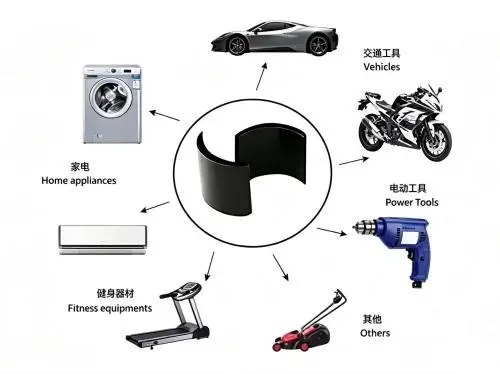
Different industries have different needs for how well rotor magnets work. Electric car traction motors need magnets that can keep up a high power density over a wide range of speeds (up to 20,000 RPM) and can handle a lot of vibration and temperature changes. For positioning accuracy at the millisecond level, industrial servo motors used in CNC and robots focus on having low cogging torque and a fast dynamic reaction. Magnets that work well with constant job cycles and being exposed to refrigerants or moisture in the environment are needed for HVAC motors and wind turbine generators. Matching the magnet's properties to stressors that are specific to the application will make sure that your motor works reliably for as long as it's supposed to.
Evaluating Supplier Capabilities and Certifications
Beyond the requirements of the materials, choosing the right provider has a big effect on the long-term success of procurement. Give more weight to partners who have ISO 9000 and IATF 16949 certifications. These show that their processes are consistent and can be tracked, which is in line with standards for making cars. Check out patent files that show technical innovation and engineering support. For example, our facility has three invention patents and six utility model patents that help with designing and optimizing custom magnets. Check the warranty options, replacement procedures, and how quickly technical support responds to reduce the risks that come with quality problems or problems that are unique to an application. Leading OEM customers also check the company's ability to produce, its ability to handle flexible transportation (such as sea freight, air freight, and fast shipping), and its compliance with environmental standards such as RoHS and SGS testing.
Procurement Insights: Where and How to Source Quality Rotor Magnets
Understanding Lead Times and Customization Options
Standard Rotor magnet for AC motors usually ship within 10 to 15 days for sample orders, which lets you make and test prototypes quickly. Lead times for bulk production runs are 35 to 40 days. This allows for precise manufacturing processes that make sure that thousands of units all have the same magnetic properties and size tolerances. Advanced providers give customized magnetic grades, post-processing surface treatments, and specialized magnetization patterns based on customer drawings or examples. Customization services go beyond just changing the sizes. When talking to possible suppliers, be clear about the minimum order amounts, batch consistency routines, and quality paperwork needs right away to avoid delays or specification mismatches that cost a lot of money.
Price Benchmarking and Cost Drivers
Rotor magnet prices vary a lot depending on the type of material, the number of orders, and the complexity of the dimensions. Neodymium magnets cost anywhere from $15 to $60 per kilogram, based on the grade and the market. Price changes are caused by the supply of rare earth raw materials. Complex shapes, like arc segments with precise corner radii (R7, R1.50, and R0.10) and tight radial thickness tolerances (8.45mm nominal), cost more because they need special tools and have to be machined in more than one step. High-precision specs are needed to keep cogging torque and dynamic imbalance to a minimum. These specifications raise the base price by 15% to 30% but improve performance in servo and traction motor uses that can be seen.
Selecting OEM and Distributor Partners
When looking at magnet suppliers, pay attention to their skills that match your buying needs and how much risk you are willing to take. Our factory has 20 years of experience in the field and is certified by both ISO 9000 and IATF 16949. This makes sure that the process is consistent and that quality can be tracked from where the raw materials come from to where the magnets are used. We have a one-year warranty that covers manufacturing defects and performance differences, and our production schedule is flexible enough to accommodate both small prototype orders and large batch orders that are placed on a regular basis. Technical support teams help you choose the right magnets, integrate motors, and improve performance. This lowers your engineering workload and speeds up time-to-market. Logistics choices like DHL, FedEx, and UPS express, along with regular sea and air freight, make sure that deliveries are always on time across global supply lines.
Maintaining and Testing Rotor Magnets for Optimal AC Motor Performance
Recognizing Signs of Magnet Degradation
Rotor magnet for AC motor performance slowly decreases due to changes in temperature, mechanical stress, and exposure to the environment. Some common signs are higher operating temperatures because of more electrical losses, more motor vibration caused by an uneven magnetic field, and lower torque output signaling flux loss. Most of the time, sudden demagnetization is caused by too many current spikes or using the magnet at temperatures above its maximum rated temperature. Motor performance measures, such as torque uniformity, efficiency curves, and temperature profiles, should be checked on a regular basis so that magnet degradation can be found early and fixed before it stops production completely.
Practical Testing and Maintenance Protocols
B2B engineering teams should use gaussmeters or fluxmeters to regularly measure magnetic flux in a Rotor magnet for AC motor system to ensure that rotor magnets maintain the specified field strength and performance levels. Visual inspections can identify coating damage, edge chipping, or corrosion that may affect the integrity of the Rotor magnet for AC motor and the overall balance of the motor assembly. High-speed operation can create vibration risks that may damage magnets, but dynamic balance testing verifies that the magnet weight distribution is uniform and that the magnets are securely mounted. Environmental controls reduce moisture exposure, thermal management limits operating temperatures, and vibration damping minimizes mechanical shock. These preventive measures extend the service life of permanent magnet components, improve motor efficiency, and reduce unexpected downtime in industrial applications where reliable Rotor magnet for AC motor performance directly impacts production efficiency.
Conclusion
In order to choose the best Rotor magnet for AC motor applications, you must weigh the benefits of magnetic performance, thermal stability, mechanical durability, and cost-effectiveness. Modern electric vehicle powertrains, industrial automation systems, and precision servo applications need magnets with high power density and high efficiency. Grades like CY35, CY36, and CY37 of neodymium magnets meet these needs. Partnering with certified suppliers that offer engineering support, customization options, reliable delivery schedules, and full warranty coverage are key to successful procurement. By making sure that the technical specs match the environment in which your motor works and carefully checking out each supplier, you can find magnet solutions that improve motor performance while keeping the total cost of ownership low over the lifecycle of the product.
FAQ
Why are neodymium magnets better than ferrite magnets in AC motor rotors?
Neodymium magnets have three to five times more magnetic flux density than ferrite magnets. This makes it possible to make small motors that have better torque-to-weight ratios. This means smaller motor housings, lower material costs, and better efficiency. This is especially helpful in electric vehicle and industrial automation uses where limited room and high energy use hurt the competitiveness of products in the context of the Rotor magnet for AC motor selection.
How can I make sure that the rotor magnet will work with the motor design I already have?
First, make sure that the dimensions match your rotor assembly. The outer radius, inner radius, radial width, and axial length must all be exactly the same to keep the air gap even and avoid mechanical interference. Make sure the magnetization direction is radial (for most AC motor uses) and the magnetic grade temperature rating is at least 20°C higher than your motor's constant working temperature to stop flux loss that can't be reversed.
Are waterproof coatings necessary for outdoor industrial motor applications?
Specialized Epoxy or Everlube coatings keep magnets safe from getting wet, being hit by salt spray, and being exposed to chemicals that are common in marine, farming, and outdoor industry settings. These treatments stop corrosion-induced flux degradation and increase service life to 15 years or more. The low cost of the coating is justified by the savings in maintenance and replacement costs.
Partner with angu for Precision-Engineered Rotor Magnets
Each Rotor magnet for AC motor that angu makes is backed by our 20 years of specialized production experience and IATF 16949 approval. Our engineers use three invention patents and six utility model patents to make sure that the magnets work best for your needs, whether they are for electric car traction, industrial servo systems, or power tool motors. We provide precise arc-segment magnets with radial magnetization that have an outer radius of 35.55 mm, an inner radius of 27.1 mm, and a radial width of 8.45 mm. These magnets come in CY35, CY36, and CY37 types that can be customized to meet your specific thermal and mechanical needs. Your production schedules will stay on track thanks to flexible international logistics and full warranty coverage. Samples will be sent out within 10 to 15 days, and bulk orders will be sent out within 35 to 40 days. Get in touch with our technical team at chenrf@angu.com to talk about your specific needs and find a dependable Rotor magnet for AC motor supplier partnership that leads to measurable performance gains.
References
1. Jian, L., & Chau, K. T. (2019). Design and Analysis of Permanent Magnet Motors for Electric Vehicles. Singapore: Springer.
2. Hanselman, D. C. (2017). Brushless Permanent Magnet Motor Design (3rd ed.). Cranston, RI: Magna Physics Publishing.
3. Campbell, P. (2018). Permanent Magnet Materials and Their Application. Cambridge: Cambridge University Press.
4. Gieras, J. F., & Wing, M. (2016). Permanent Magnet Motor Technology: Design and Applications (4th ed.). Boca Raton, FL: CRC Press.
5. Pyrhönen, J., Jokinen, T., & Hrabovcová, V. (2020). Design of Rotating Electrical Machines (2nd ed.). Chichester: John Wiley & Sons.
6. Liu, K., & Zhu, Z. Q. (2021). "Temperature Rise Analysis in Permanent Magnet Synchronous Motors Considering Material Properties and Operating Conditions," IEEE Transactions on Industrial Electronics, 68(4), 2854-2864.
YOU MAY LIKE