A Complete Guide to the Magnet for motor rotor
Modern electromechanical systems require Magnet for motor rotors, which have led to automotive, industrial, and green energy advances. High-performance motor rotor magnets are composed of NdFeB, SmCo, or Ferrite. A continuous magnetic field is created inside the rotating unit. Rotational force comes from this magnetic field and stator windings. This makes motors strong and energy-efficient. Procurement managers, R&D engineers, and supply chain workers must understand rotor magnet selection to satisfy performance goals and maximize TCO.
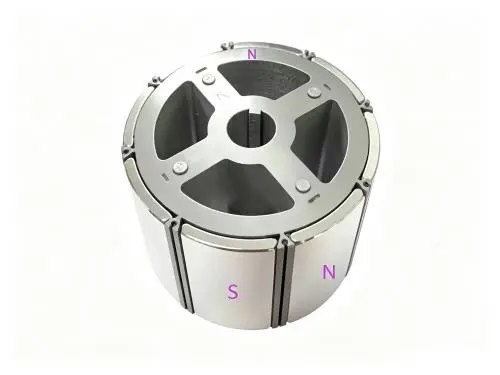
Understanding Magnet Types Used in Motor Rotors
Choosing the correct Magnet for motor rotor material affects motor performance, heat handling, and lifespan. Buying the appropriate material is wise since various purposes require different magnetic characteristics.
Neodymium (NdFeB) Magnets: The High-Performance Standard
Most high-efficiency motors employ neodymium magnets because they produce 52 MGOe of magnetic energy. These magnets have remanence (Br) values between 1.1T and 1.48T, allowing smaller motor designs without reducing power. With SH, UH, or EH temperature grades, NdFeB magnets may function continuously in electric car drive systems around 180°C. The intrinsic coercivity (Hcj) is generally greater than 25kOe, making it resistant to demagnetization during high-current transients like regenerative braking or fast acceleration.
Ferrite Magnets: Cost-Effective Reliability
Low-space buying teams can save money on ferrite magnets. These ceramic-based magnets don't need corrosion protective coatings; they require less maintenance. Despite its lower magnetic strength—3.5–4.5 MGOe—ferrite magnets operate well in industrial motors, pumps, and HVAC systems where cost-effectiveness and continuous job cycles are more essential than peak performance.
Samarium Cobalt (SmCo): Extreme Environment Specialist
Samarium Cobalt is utilized when NdFeB cannot withstand high temperatures or corrosive conditions. Up to 350°C, SmCo magnets retain their magnetic characteristics and resist degradation. Due to its thermal stability, SmCo is employed in aircraft actuators, high-speed rotary compressors, and downhole drilling motors despite its higher cost. SmCo is generally chosen after a total lifetime cost evaluation demonstrates that system failure and replacement costs exceed material prices.
You must consider operational temperature ranges, environment, power consumption, and budget to establish the ideal material balance. Our ISO 9000 and IATF 16949-certified production techniques provide consistent magnetic characteristics across batches. This satisfies Tier 1 auto and industrial equipment vendors' quality stability criteria.
Magnet Design Principles for Motor Rotors
Magnet for motor rotor design goes beyond material selection to maximize motor performance. It also involves form optimization, heat management, and magnetic flux control.
Magnetic Flux Distribution and Pole Configuration
Torque and system smoothness depend on magnetic pole order. Finite element analysis (FEA) models magnetic field interactions for engineers. They then determine the ideal pole spacing to decrease cogging torque, the jerky resistance you experience when the motor spins slowly. Segmented magnet designs reduce high-speed eddy current losses and simplify automatic production assembly by using arc segments instead of rings.
Magnet for motor rotor: We can build objects with accurate dimensions up to R36 (+0.2 / -0.1) mm for the outer arc radius and R28.3 (+0.3 / 0) mm for the inner. These tolerances ensure the air gap is always the appropriate size, which affects magnetic field regularity and motor efficiency. In EV traction motors and industrial servo systems, magnetic flux density must balance structural weight constraints. The optimal parameters are 22 (+0 / -0.4) mm axial height and 7.6 (+0 / -0.2) mm breadth.
Thermal Management Strategies
Increased temperature lowers magnetic performance as predicted. Thermal design is crucial for long-term operation. Grain boundary diffusion (GBD) adds heavy rare-earth elements like dysprosium or terbium solely at grain boundaries in high-quality NdFeB magnets. This approach balances cost and thermal resilience by increasing temperature stability without employing too many rare earths.
Rotor design helps heat escape. Our typical configurations have an axial length of 62 ±1 mm and a width of 50 (+0 / -1) mm. Air-cooled motors have enough surface area for convection cooling at these sizes. The typical 90° ±2° angle at either end simplifies segmented rotor stack assembly, enabling coolant flow channels in liquid-cooled high-performance racing and heavy-duty industrial gear for consistent performance.
Cogging Torque Minimization
Cogging torque, the force between stator teeth and rotor magnets, makes robot control difficult and consumer electronics noisy. Design solutions include magnet skewing, pole arc minimization, and asymmetric slot layouts, which reduce this impact. OEM companies use our technical team to create magnet shapes for stator designs. Our three innovation patents and six utility model patents help them create the finest solutions that satisfy the highest performance criteria.
Comparison of Rotor Magnets: Efficiency, Materials, and Application Suitability
Know the benefits and downsides of different Magnet for motor rotor designs to make educated purchases for your application.
Permanent Magnet Synchronous Motors vs. Induction Motors
Induction motor slip losses are eliminated by adding rotor magnets to PMSM. This simple difference boosts efficiency by 3–5%. Since every watt-hour enhances range, battery-electric automobiles need this. Eliminating rotor windings reduces I²R losses and simplifies thermal control. Small motor envelopes are crucial for areas with restricted space.
Induction motors are superior when they need to be powerful or exposed to metal debris that might harm the magnet. Purchase relies on lifespan cost research. Permanent magnet motors cost more initially but save money by using less energy and requiring less maintenance.
Brushless vs. Brushed Motor Magnets
Brushless motors eliminate carbon brush commutation wear by using a magnet for motor rotor. This design extends maintenance intervals for hard-to-reach HVAC fans, e-bike propulsion systems, and generator blades, which are expensive to repair. Generator blades, electric vehicle motors, industrial motors, and e-bike and scooter motors may employ our strong magnets.
Brushed motors are still utilized where cost and simplicity are more essential than economy. Lower-grade ferrite is used in brushed magnets. These technologies are more advanced and have different performance and cost specifications.
High-Speed Applications and Structural Considerations
Above 20,000 RPM, motors exert intense spinning pressures that stress the magnet-rotor interface. Magnets are protected from high spinning speeds by carbon fiber tubes or stainless steel retaining cans. Our industrial methods employ multi-layer Ni-Cu-Ni, Zinc, or Epoxy coatings. These coatings resist corrosion and retain adhesion while mechanically strained and when temperatures fluctuate.
New models emphasize weight reduction without sacrificing magnetic strength. Advanced sintering and alloy modifications provide higher-energy products with less material. This allows lighter rotors with reduced bearing loads and improved dynamic response for robotics and airplanes.
Procurement Insights: Buying and Custom Manufacturing of Motor Rotor Magnets
Strategic Magnet for motor rotor purchases requires more than unit pricing consideration.
Supplier Qualification Criteria
Reliability begins with quality standards. Our ISO 9000 and IATF 16949 certifications demonstrate our automobile industry-standard quality management. These certifications demonstrate that process controls maintain dimensions, magnetic characteristics, and tracking. These are crucial for OEM batch-based recurring procurement.
In addition to credentials, specialist skills distinguish dealers. Three concept patents and six utility model patents demonstrate our constant innovation in magnet design and production. When conventional items need to be modified, this degree of technical depth allows individuals to collaborate on solutions. This accelerates development and reduces prototype costs.
Custom Manufacturing Capabilities
Standard shop products seldom fit custom motors. Based on client designs or samples, our OEM/ODM services may create parts to particular sizes, dimensions, and performance levels. Custom magnetization patterns and surface treatments fulfill performance or environmental objectives.
Order type determines lead time. Standard sample development takes 10–15 days, allowing speedy idea testing. Our 20 years of manufacturing and well-organized production procedures allow us to ship large orders in 35 to 40 days. Set delivery windows simplify just-in-time inventory techniques while maintaining additional stock for demand fluctuations.
Logistics and Global Supply Chain Considerations
Magnet for motor rotor. International purchases require flexible logistics. For cheaper large deliveries, we utilize sea freight. Air freight speeds delivery during manufacturing ramp-ups. We utilize DHL, FedEx, and UPS for prototype and sample orders. Our neutral interior boxes and moisture-, shock-, and pressure-resistant exterior containers protect items throughout overseas transportation. Distributor contacts might include custom packaging for handling needs or brand preferences.
Pricing Dynamics and Cost Management
Global events and mine output affect raw material prices, notably rare earth elements utilized in NdFeB magnets. Smart procurement strategies include long-term supplier arrangements that stabilize pricing and enable realistic cost models for multi-year product lifecycles. Our simple pricing approach considers material cost, process difficulties, and order volume. It aids value engineering discussions that optimize performance-to-cost ratios.
After-Sales Support and Warranty Programs
Our one-year warranty eliminates capital equipment risk by covering manufacturing defects. Quality issues prompt timely repairs, minimizing manufacturing delays. Third-party test findings from RoHS and SGS fulfill international market documentation requirements if requested. This all-around after-sales approach fosters long-term supplier relationships that procurement directors look for when calculating the total cost of ownership.
Maintenance, Common Issues, and Troubleshooting for Motor Rotor Magnets
When you take care of your magnets, they'll last longer and won't shatter unexpectedly. Magnet for motor rotor maintenance, typical issues, and solutions are essential for reliability.
Demagnetization Risks and Prevention
Magnets lose their magnetic strength permanently at temperatures over their thermal limit. Checking bearing temperatures and airflow helps prevent thermal excursions. Too many fault current spikes demagnetize fields. The correct motor controller safety circuits limit this danger. Hall effect sensors measure magnetic flux and detect progressive demagnetization before it impacts operations.
Physical Damage and Corrosion Management
Magnets shatter easily when handled or assembled. Coatings protect corrosive environments, but deterioration renders them vulnerable. Regular maintenance inspections detect layer degradation early, allowing targeted repairs before base material oxidation decreases magnetic characteristics. Keep items in climate-controlled rooms with humidity below 60% and store them properly to prevent corrosion.
Diagnostic Techniques
Back-EMF measurements allow rotor magnet inspection without damage. A steady-speed dropping back-EMF indicates magnetic strength loss. Vibration analysis detects rotor instabilities produced by loose magnets or fractures. Thermal imaging during operation indicates hot patches that may indicate magnetic loss or an electrical issue. Diagnoses enable condition-based maintenance, which increases inspections and resource utilization.
Use this magnet maintenance advice to maximize your investment. They will keep the motor operating efficiently for as long as possible and maintain production managers' operations uniformity.
Conclusion
Magnets for motor rotors are significant to materials science and electrical system efficiency. You must balance cost, application-specific demands, magnetic characteristics, heat resistance, dimensional correctness, and supply chain stability while buying. Neodymium magnets are the most powerful, ferrite magnets are cheap and stable, and Samarium Cobalt magnets operate best in tough environments. Design improvement, including heat management, cogging reduction, and pole arrangement, transforms materials' potential into measurable motor performance benefits. Selecting a seller based on credentials, technical expertise, customisation services, and transportation freedom ensures long-term competitive advantage.
FAQ
What advantages do neodymium magnets offer in motor rotor applications?
Neodymium magnets, which may reach 52 MGOe, have the highest magnetic energy product of any store-bought material. Because it is so robust, motor designers may make the rotor smaller and lighter while maintaining or increasing power. Small motor designs from this reduce material costs and improve power-to-weight ratios for electric automobiles and airplanes.
How does magnet design influence overall motor efficiency?
Optimizing a magnet shape minimizes cogging torque and harmonic field losses by changing the magnetic flux distribution. Segmented geometries reduce eddy current losses in high-speed running. Right thermal control keeps magnetic characteristics within designer specifications. This maintains efficiency throughout operation. Motor efficiency can increase by 2–4% due to these design features.
Can I order custom-shaped magnets for specialized motor designs?
Of course. Our OEM/ODM production services can match sizes, tolerances, and forms to CAD designs or samples. We aid with engineering and utilize FEA modeling to discover the ideal magnet shapes for your stator configuration and performance goals throughout design.
Partner with a Trusted Magnet for Motor Rotor Supplier
Angu has made Magnet for motor rotors for 20 years for automobile suppliers, industrial equipment makers, and OEMs worldwide. Our ISO 9000 and IATF 16949-certified techniques provide precise measurements and magnetic uniformity for your applications. Our engineers collaborate to create the greatest designs, and our patent portfolio supports them. This applies to both conventional arc segments with an outer arc radius of R36 and fully customized designs. You may expect 30-day delivery, flexible worldwide operations that accommodate sea freight and expedited shipping, and a quality guarantee.
Contact our technical specialists at chenrf@angu.com to discuss motor rotor magnet needs. We'll provide detailed requirements, affordable costs for bulk orders, and engineering advice to speed up your project. Peace of mind comes from working with a well-known maker whose quality and service satisfy your operating excellence criteria.
References
1. Hanselman, D. C. (2006). Brushless Permanent Magnet Motor Design, 2nd Edition. The Writers' Collective.
2. Hendershot, J. R., & Miller, T. J. E. (2010). Design of Brushless Permanent-Magnet Machines. Motor Design Books LLC.
3. Gieras, J. F., & Wing, M. (2002). Permanent Magnet Motor Technology: Design and Applications, 2nd Edition. Marcel Dekker, Inc.
4. SAE International. (2020). Electric Motor Technologies for Automotive Applications (Technical Paper Series). Society of Automotive Engineers.
5. Li, W., & Qian, Z. (2018). Thermal Management of Permanent Magnet Motors in Electric Vehicles. IEEE Transactions on Industry Applications, 54(4), 3550-3560.
6. Brown, G., & Seymour, R. (2019). Rare Earth Elements in High-Performance Permanent Magnets: Material Science and Supply Chain Considerations. Materials Research Society Bulletin, 44(4), 258-265.
YOU MAY LIKE