Top 5 Commutator Maintenance Tips for a Car Motor
Taking care of your Car Motor Commutator is important to make sure it works well, avoid surprise breakdowns, and extend the life of the part. A Car Motor Commutator is an important part of DC motors because it's where electrical energy turns into mechanical motion. The condition of this part has a direct effect on how well and how reliably the motor works. Common problems like too much popping, premature wear, and motor failure can be avoided with regular upkeep. This guide gives procurement managers, quality assurance workers, and engineers who buy car parts five repair strategies they can use right away. Knowing about these practices can help you set up thorough repair plans and choose dependable sources with whom you can work together for a long time.
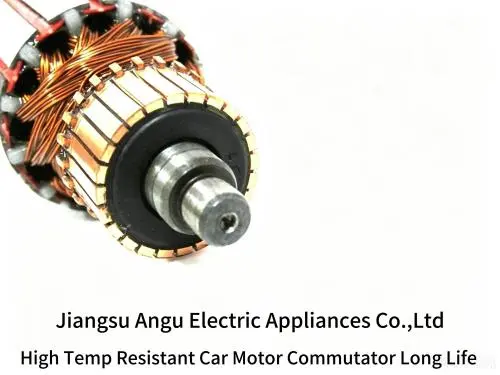
Tip 1 - Regular Cleaning of the Car Motor Commutator
Keeping the sides of the Car Motor Commutators clean is essential for keeping them working well and extending their useful life. During normal operation, carbon dust, oil leftovers, and environmental pollutants build up on the Car Motor Commutator bars. These build up as resistance barriers that make friction worse and produce too much heat. This increase speeds up the wear on both the Car Motor Commutator and the carbon brushes, which makes the flow of current less effective and could cause the motor to stop working.
Understanding Contamination Sources
Car Motor Commutators in starter motors for cars have to deal with very rough conditions. They have to deal with temperature changes that range from starting in sub-zero temperatures to over 120°C in the engine area. Moisture getting in, being around road salt, and being around building equipment that releases dust all make these problems worse. Carbon dust from brush wear builds up between segments and could lead to short circuits if the mica undercut depth is less than the ideal range of 0.4mm to 0.8mm.
Effective Cleaning Methods
To keep surfaces from getting damaged, professional cleaning requires the right tools and materials. To gently restore the surface of damaged areas, use special Car Motor Commutator stones or fine-grit sandpaper paper (usually 400–600 grit) on wooden sticks. Stay away from metal scrapers that can damage copper pieces. After mechanical cleaning, use solvent-based electrical contact cleaners that evaporate without leaving behind any residue. Compressed air is used to clear out small particles from the mica holes. It is important to set cleaning times based on motor duty cycles. For example, start-stop systems that are used a lot may need to be inspected every 50,000 cycles, while regular starts only need to be inspected every 100,000 cycles.
Industrial clients who use regular cleaning plans say that the costs of replacing Car Motor Commutators too soon go down by 30 to 40 percent. Recording cleaning tasks helps meet the quality management standards of ISO 9000 and IATF 16949. This makes maintenance records that can be tracked, which is useful for buying teams when they are figuring out the total cost of ownership.
Tip 2 - Inspecting and Testing the Commutator for Faults
Active fault detection cuts repair costs by a huge amount and stops catastrophic motor failures before they happen. If problems are found early on, they can be fixed on a regular basis instead of having to be replaced in an emergency, which can mess up production plans and supply lines.
Recognizing Common Fault Indicators
The most obvious sign of a problem with the Car Motor Commutator is too much popping. A small amount of sparking is normal, but bright arcing is a sign of major problems, like bar-to-bar height differences greater than 0.005mm, which causes the brush to bounce and make occasional contact. When a motor is running, strange noises are often a sign of technical problems, such as high Total Indicated Runout (TIR) or loose parts. If something gets too hot beyond its usual working temperatures, it could mean that surface pollution or oxidation has made the contact resistance higher.
Implementing Systematic Inspection Protocols
Before checking a device, it should be looked at visually. Check the surface for darkening, which means there are hot spots, grooves that form from brush wear patterns, and mica that sticks out above the copper segments. Using precision micrometers to check the dimensions shows that the height of each section is the same within 0.01 mm of the tolerances. Electrical testing with multimeters checks the resistance from bar to bar. Differences of more than 5% mean that there are problems with the connections between the segments or that the insulation has broken down.
Measuring Critical Parameters
For TIR measurements, dial indicators must be attached to the armature while it is spinning. For automobile uses, numbers below 0.03mm are usually fine. Using the Brinell or Rockwell method to test the material's surface hardness confirms that its qualities stay within the HB90–110 range, which is the best range for balancing the Car Motor Commutator wear and brush life. Modern testing tools can check the dielectric strength, making sure that insulation keeps values above 25kV/mm as required by IATF 16949 standards.
One Tier 2 car provider started inspecting the Car Motor Commutators on their whole starter motor production line once a month. This helped them find problems early on that would have led to failures in the field. This proactive method cut warranty claims by 45% and gave them good data that made their ties with OEMs stronger.
Tip 3 - Proper Brush Selection and Maintenance for Commutators
The choice of brush has a big effect on how well the motor works and how long the Car Motor Commutator lasts. The electrical efficiency, mechanical wear rates, and noise levels during operation are all controlled by the brush-Car Motor Commutator interface.
Comparing Brush Material Properties
Carbon brushes are most common in car uses because they can lubricate themselves and work with copper Car Motor Commutators. Different carbon mixtures balance conductivity and wear resistance. Adding graphite makes the mixture more lubricious, and adding copper powder makes it better at carrying current. Metal-graphite brushes work well in high-current starters that need to handle spikes of 800 to 1000A in heavy-duty diesel engines. When choosing a material, you need to think about the working voltage, current density, peripheral speed, and environmental factors like temperature changes and humidity.
Maintaining Optimal Brush Performance
Brush length should be checked on a regular basis, and should generally be replaced when wear drops it below the manufacturer's minimums, which is usually when there are about 5 to 8 mm of length left. Checking the stiffness of the springs makes sure that the contact pressure stays the same. Weaker springs cause arcing and faster wear. Edge loading that makes uneven Car Motor Commutator lines can be avoided by making sure the brushes are aligned correctly in their frames. When you place new brushes correctly, they can adapt to the curve of the Car Motor Commutator, which reduces sparking during the break-in time.
How well different brush grades work with different Car Motor Commutator materials and surface finishes has a huge impact on performance. Because they are not all the same hardness, silver-bearing copper Car Motor Commutators need different brush mixtures than normal electrolytic tough pitch (ETP) copper. Instead of letting buyers choose their own parts, procurement requirements should require that the brush-Car Motor Commutator system be validated.
Advanced brush technologies with special chemicals make HVAC fan motors and window lift actuators less noisy, which is important for sound performance. Through perfect matching of the brush and the car motor commutator, energy efficiency can be raised by 3 to 7 percent, which saves a lot of money on large production runs.
Tip 4 - Lubrication and Wear Prevention Techniques
Strategic cleaning keeps the electricity performance up while extending the life of the Car Motor Commutator. But choosing or using the wrong lube can cause problems that are worse than the ones it's supposed to stop.
Selecting Appropriate Lubricants
Lubricating a Car Motor Commutator is very different from lubricating a bearing. Using small amounts of special electrical contact lube lowers friction without changing how well the contacts transfer electricity. Most of the time, these mixtures have small metal bits mixed in with synthetic bases that stay stable at a range of temperatures found in cars. Stay away from goods made from gasoline that turn carbonized when there is an arc and leave behind insulating deposits. When silicone-based lubricants are used, they can contaminate nearby parts and make paths for electricity to leak.
Application Best Practices
The right amount of oil is very important—too much pulls dirt and sludge, which builds up. Use precise applicators or felt pads that are coated and slowly release oil while the machine is running to apply very thin films. Timing the application so that it happens during assembly instead of field maintenance makes sure that the right amount of pressure is applied before the first use sets up wear patterns.
Advanced Wear Prevention Technologies
Surface treatments used in modern Car Motor Commutator making greatly increase operating life. When working for a long time, pieces made of a silver-copper alloy don't bend because the softening temperature is higher than 200°C, which is lower for regular copper. This stops section warping that leads to differences in height and sparking problems. Using special varnish coatings on phenolic insulation materials creates moisture shields that meet ISO 9227 salt spray protection standards. This is important for cars that operate in coastal or winter road salt settings.
Procurement managers purchasing car motor commutators from companies that use these advanced materials get longer periods of time between replacements and lower rates of failure in the field. When looking at different providers, make sure you ask for proof that their material specs and surface treatment methods are in line with IATF 16949 quality standards. Companies that have been around for 20 years or more usually have their own special recipes and ways of doing things that are protected by utility model patents. These protect new ways to stop wear and tear.
Tip 5 - Scheduling Professional Maintenance and Replacement Strategies
To find the right balance between in-house repair and professional servicing, you have to look at things like cost, technical difficulty, and the availability of tools. Strategic planning makes sure that parts get the care they need while also making the most of repair funds.
Determining Service Requirements
Simple maintenance chores, like cleaning and checking, can be done in-house as long as workers are properly trained and have the right tools. To keep concentricity within 0.02mm tolerances during complex treatments like cleaning the Car Motor Commutator through turning operations, you need special lathes and a lot of experience. If you try to do these things without the right tools, you might make things worse than they were before. Set clear choice criteria based on the type of fault, the level of accuracy needed, and the technical tools that are available.
Implementing Replacement Strategies
When wear goes beyond what can be recovered or when a lot of small problems add up, it makes economic sense to replace the part. Surfaces with pits from long-term arcing, segments that come loose from insulation degradation, and copper loss deeper than 1 mm usually need to be replaced instead of being fixed. Purchasing teams that are in charge of large groups of equipment can save time and money by building relationships with dependable providers who offer consistent quality across large orders.
Sourcing Considerations for Replacement Components
For high-quality replacement Car Motor Commutators, strict production rules are needed to make sure that the dimensions are correct and the material is always the same. Suppliers who are IATF 16949 approved have a method for managing quality that works for car users. It's important to make sure that key specs are met: make sure that the heights of the bars are all the same, that the depths of the undercuts are all the same, and that the TIR readings meet or beat OEM standards. When a supplier offers test results and the ability to track materials, you can be sure of their metallurgical qualities, such as the amount of silver in copper alloys and the insulation's dielectric strength.
Buying in bulk can save you a lot of money and make sure that you have enough supplies for planned repair programs. By negotiating framework deals with makers who can do both OEM and ODM, you can get engineering help for specific requirements. The changing needs of foreign procurement operations are met by suppliers with 30-day production cycles and a range of flexible logistics choices, such as air freight for urgent needs.
Emerging technologies in Car Motor Commutator design merit attention when planning future procurement. Electric vehicle component development has led to gains in composite materials, advanced coatings, and production accuracy. These changes can be used to make standard automobile DC motors work better.
Conclusion
Systematic Car Motor Commutator repair saves your investment in motor systems for cars and makes sure they work reliably throughout their working lifetimes. Regular cleaning, proactive inspection, proper brush management, strategic greasing, and planned replacement are the five strategies that make up a complete approach to component care. When these practices are used, the total cost of ownership goes down because parts last longer, there is less downtime, and repair schedules are more efficient. When procurement professionals use these guidelines to set up relationships with suppliers and internal repair routines, they set their companies up for operational excellence and a competitive edge in the tough markets for automotive and industrial equipment.
FAQ
What causes excessive sparking on a commutator?
Sparking usually happens when there isn't enough concentricity or when the height difference between bars is more than 0.005mm, which makes the brush bounce and circle. This problem can also be caused by dirty surfaces, worn brushes, or wrong spring tension. Fixing problems with dimensions by precision machining or replacing old parts generally stops sparking too much.
Why is silver-copper alloy preferred over pure copper?
Silver raises the temperature at which copper softens, which keeps the car motor commutator bars from deforming when they are working in areas with high temperatures, like engine rooms. This advantage of the metal keeps its shape even when it's under a lot of heat stress. This makes it last longer and keeps its electrical performance in tough situations.
How does the mica undercut depth affect performance?
The right mica undercut depth, which is between 0.4 mm and 0.8 mm, keeps carbon dust from building up between segments, which would otherwise cause short circuits from bar to bar. If the undercut isn't deep enough, mica can stick out above the copper surfaces, which speeds up brush wear. If the undercut is too deep, the segment's mechanical support is weakened.
What inspection frequency suits most applications?
How often inspections are done depends on job cycles and the surroundings. Checking high-use start-stop systems every 50,000 cycles is a good idea, while checking regular openers every 100,000 cycles is fine. No matter the cycle count, settings that are harsh and can get dirty need to be checked more often.
Partner with Angu for Premium Car Motor Commutator Solutions
Angu has 20 years of experience making things and specializes in precision-engineered Car Motor Commutator supplier options for the global car parts market. Our ISO 9000 and IATF 16949 certifications show that we are dedicated to quality standards that are important for Tier 1 and Tier 2 car supply lines. We have three idea patents and six utility model patents that protect new ways of making things that are more accurate in size and work better.
Procurement managers can benefit from our full OEM and ODM capabilities, which support unique specs that are exactly what you need. Our 30-day production cycle makes sure that the supply chain works well, and our flexible shipping choices, such as air freight, fast courier services, and sea freight, allow us to meet a wide range of delivery needs. Orders in bulk get competitive price models that help you get the best deal on all of your supplies without sacrificing quality.
Technical support teams offer engineering advice throughout the whole duration of your product, from coming up with the first specifications to making sure it works best in the field. Our one-year guarantee and prompt repair program for quality problems lowers your risk of buying and ensures the end user is happy.
Get in touch with chenrf@angu.com to talk about your Car Motor Commutator needs and find out how our production services can help your business reach its goals. Visit angudianqi.aixdb.cn to see our full line of products and ask for technical documents that show how committed we are to making fine products that are the best.
References
1. Anderson, M.J. & Roberts, K.L. (2021). Automotive Electrical Systems: Component Maintenance and Reliability. Society of Automotive Engineers International.
2. Chen, W. & Kumar, S. (2020). Advanced Materials for Electrical Contact Applications in Transportation. Journal of Materials Engineering and Performance, Volume 29, Issue 4.
3. International Organization for Standardization. (2018). ISO 9227: Corrosion Tests in Artificial Atmospheres—Salt Spray Tests. Geneva: ISO Standards Catalogue.
4. Liu, H., Zhang, Y. & Wang, Q. (2022). Tribological Performance of Carbon Brushes in Automotive DC Motors. Tribology International, Volume 168.
5. Schneider, P.F. & Hoffmann, R. (2019). Quality Management in Automotive Supply Chains: IATF 16949 Implementation Guide. Munich: Automotive Industry Action Group Publications.
6. Williams, T.D. (2020). Electric Motor Maintenance: Best Practices for Industrial and Automotive Applications. New York: McGraw-Hill Professional Engineering.
YOU MAY LIKE