High Conductivity Automotive Copper Commutator for EV Motors
A precision-engineered rotary electrical switch called an Automotive Copper Commutator transfers electrical energy into mechanical torque in electric vehicle (EV) motors. Understanding these components' technical specifications and performance characteristics is crucial for purchasing managers and R&D engineers assessing supplier capabilities. High-conductivity copper commutators provide high electrical efficiency, low energy loss, and long service life under rigorous operating circumstances. The appropriate commutator affects motor dependability, cost-per-mile efficiency, and overall ownership costs throughout automotive supply chains.
Introduction
Electric vehicle components need high conductivity and mechanical endurance. The commutator connects stationary brushes to revolving armature windings, assuring a power supply for thousands of cycles. Contemporary EV motors run at high speeds and temperatures, straining commutator materials and manufacturing accuracy.
Purchasing teams are under pressure to find suppliers that can fulfill worldwide automotive standards and offer consistent quality at low prices. Patent-backed manufacturing innovations, IATF 16949 certification, and flexible OEM/ODM capabilities distinguish reputable partners from commodity vendors. This resource helps tier 1 and tier 2 automotive suppliers make educated procurement choices by covering technical criteria, material comparisons, and sourcing methods.
Precision-manufactured copper commutators are in demand as the global EV industry grows. Supply chain managers need partners that can balance conductivity, manufacturing scalability, and delivery dependability in 30 days.
Understanding Automotive Copper Commutators and Their Role in EV Motors
Definition and Function in EV Applications
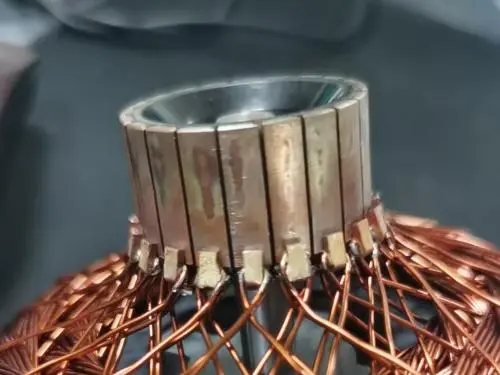
EV auxiliary systems and certain traction applications use copper commutators as mechanical rectifiers to preserve unidirectional torque in DC motors. Multiple copper segments are insulated and put on a revolving shaft. Carbon or graphite brushes touch these segments to route electricity through the armature windings in succession while the motor spins.
For motor torque and speed optimization, the 20-segment design configuration includes units with an outer diameter of 30.33mm, an inner diameter of 9.96mm, and a height of 18.5mm. Each section must be electrically isolated and endure centrifugal forces of 20,000 RPM in certain situations.
Working Principle and Electrical Conduction
The commutation method uses split-second brush transitions between copper segments. High-purity silver copper alloys (CuAg 0.03 or 0.08) have conductivity exceeding 97% IACS, reducing resistive heating and performance degradation. Mechanical strength and electrical isolation between segments make the resin bonding system resistant to thermal expansion cycles from -40°C to +150°C.
The commutator aligns the motor's magnetic field polarity with mechanical rotation during each revolution. Synchronized switching minimizes torque reversal and ensures power supply throughout load circumstances. Commutation quality is influenced by manufacturing accuracy, since surface roughness below Ra 0.8μm lowers brush friction and electromagnetic interference.
Material Advantages Over Alternatives
Silver-bearing copper offers higher softening temperature resistance than electrolytic copper, avoiding segment deformation during high-current beginning sequences. Copper has 60% better electrical conductivity than aluminum, reducing energy loss and improving motor performance. Brass commutators are cheap but lose conductivity and degrade faster under continuous duty cycles.
Key Performance Factors of High Conductivity Automotive Copper Commutators
Durability Under Extreme Operating Conditions
Material limitations are tested by heat cycling, mechanical vibration, and electrical arcing in EV motor commutators. Quality commutators resist segment lifting and resin breakdown at 150°C. Molding must accomplish perfect copper-to-resin bonding that survives centrifugal stress testing at 1.5 times rated operating speeds.
Applications exposed to dampness, road salts, and vehicle fluids need corrosion resistance. Surface treatments and alloy choice influence commutator electrical characteristics throughout time. Salt spray exposure, thermal shock cycling, and humidity chamber validation are performed on ISO 9000 and IATF 16949 components.
Product Types and Customization Options
Standard configurations service popular motor designs, while customized solutions meet voltage, current, and dimensional needs. OEM collaborations optimise commutators for proprietary motor topologies with segment geometry, insulation systems, and shaft mounting interfaces.
High-performance variations include upgraded materials and manufacturing methods that expand operating envelopes. These may include diamond-turned surface polishing for ultra-low friction, specialized resin compositions for severe temperature stability, or increased silver content for conductivity. Engineering assistance from vendors helps procurement teams match commutator specs with motor performance requirements.
Common Failure Modes and Preventive Maintenance
Bar rise—where copper segments protrude from the commutator—is caused by insufficient molding pressure or thermal expansion mismatch. This scenario increases brush wear and electrical noise that disrupts car electronics. High-tonnage molding and thermal stress modeling are preventive design steps.
Insulation breakdown via electrical arcing or mechanical degradation causes segment-to-segment shorts. Before components reach production lines, bar-to-bar resistance and hi-pot dielectric breakdown tests detect these issues. A good brush material and commutator surface polish reduce arcing during operation.
Depending on duty cycle severity, automobile OEM regulations propose visual inspection every 1,000 operating hours and replacement when surface wear reaches 0.5mm or electrical resistance measurements vary outside limits.
Comparing Materials and Solutions for Automotive Commutators
Copper Versus Alternative Materials
Copper has a conductivity advantage over aluminum: pure copper has 100% IACS (International Annealed Copper Standard), whereas aluminum has 61%. This 40% performance disparity affects motor energy efficiency and heat production, making Automotive Copper Commutator components a preferred choice for applications requiring reliable current transmission and thermal performance. Brass alloys are in between but include zinc, which lowers conductivity and mechanical strength compared to pure copper.
Brushless DC motors use carbon commutators for electrical commutation to decrease mechanical wear. Carbon's electrical resistance is far greater than metallic alternatives, limiting current capacity. Procurement teams must weigh cost, performance, and application-specific needs against motor specifications when choosing materials.
Copper's greater performance, longer motor lifetime, and lower maintenance costs justify a premium price despite commodity market fluctuations. Energy efficiency improvements, warranty expenses, and premature component failure, as well as manufacturing line downtime, must be included in total cost of ownership estimates.
High-Performance Copper Variants
Silver-copper alloys, the best copper commutators, improve thermal performance without affecting electrical conductivity with silver concentration between 0.03% and 0.1%. Silver increases the softening point by 50°C, which is important for starting motors with short-term current spikes above 1,000 amperes.
Fuel pump motors working in chemically hostile settings like E85 ethanol blends benefit from oxygen-free copper formulations that avoid internal oxidation that degrades conductivity. Controlled atmospheres limit oxygen absorption during melting and casting, retaining electrical characteristics.
Application-Specific Selection Criteria
Starter motor applications need high current capacity and burst strength, hence silver-bearing copper with reinforced resin is preferred. HVAC and cooling fan motors need accurate surface finishing and balanced segment combinations for reduced acoustic noise and smooth commutation. Submerged, chemically demanding fuel pump motors need corrosion resistance and sealed construction.
Understanding these application characteristics helps procurement teams define commutator grades without over-engineering typical applications or under-specifying difficult situations. Supplier technical support optimizes performance and cost by matching product versions to motor needs.
Sourcing and Procurement of Automotive Copper Commutators for EV Motors
Evaluation Criteria for Supplier Selection
Supplier evaluation relies on certificate verification. ISO 9000 certifies fundamental quality management systems, whereas IATF 16949 handles automotive industry needs, including manufacturing part approval and sophisticated product quality planning. Material composition and performance claims are independently verified by SGS.
Patents show technical innovation, with invention patents showing manufacturing breakthroughs and utility model patents showing design enhancements. Multiple patent suppliers engage in R&D to adapt to EV motor technology. Twenty years of manufacturing experience imply reliable production procedures and edge case and application-specific knowledge.
Comprehensive one-year warranties with explicit replacement procedures imply production quality and prompt after-sales service. Purchase managers should obtain warranty coverage information, including remedy timescales, replacement logistics, and quality problem investigation methods.
Supply Chain Reliability Factors
Production capacity verification assures suppliers can grow to meet volume needs without quality loss. Delivering 50,000 items in 30 days shows factory throughput and supply chain management. Backup capacity and contingency planning distinguish resilient providers from interruption-prone ones.
For international procurement of Automotive Copper Commutator, vendors supplying sea freight for cost effectiveness, air freight for quicker delivery, and rapid courier services for sample validation provide the agility contemporary supply chains need. Cartons, pallets, and containers should match receiving facility capabilities and inventory management systems.
Engineering validation occurs before manufacturing volume commitment with free sampling. Samples show supplier trust and decrease procurement risk by permitting performance verification under real operational settings before full-scale purchases.
Cost Structure and Pricing Trends
Material costs account for 40-60% of commutator production costs, and the copper commodity price affects them. Suppliers who provide price stability or advance contracts lessen metal market volatility for procurement teams. Tiered pricing models increase cost competitiveness for high-volume OEM contracts with volume commitments.
Customization prices depend on tooling and design complexity. Fully bespoke designs need amortizing tooling expenditures over production quantities, whereas standard setups with existing equipment provide the lowest per-unit costs. Suppliers with vast standard product ranges limit application customisation, speeding time-to-market and lowering costs.
Along with unit price, total landed cost estimates must include shipping, customs, and inventory carrying costs. Suppliers with streamlined logistics networks and international trade paperwork knowledge improve procurement and decrease hidden expenditures that increase acquisition prices.
Future Trends and Innovations in Automotive Copper Commutators for EV Motors
Emerging Manufacturing Technologies
Advanced molding processes with multi-stage pressure profiling tighten copper-to-resin bonding and lower internal stress. These advancements reduce segment lifting, which shortens commutator lifetime, extending operating life. Computer-controlled manufacturing reduces defects and warranty claims by ensuring batch quality.
Beyond machining, surface finishing technologies evolve. Diamond turning decreases brush friction and electromagnetic interference with sub-micron surface roughness. Micro-textured surfaces from laser ablation improve the boundary layer between copper segments and carbon brushes, enhancing commutation efficiency.
Alloy development improves thermal performance and electrical conductivity. Trace elements in proprietary copper formulations increase grain structure and mechanical qualities without reducing copper's conductivity, making it the ideal commutator material.
Market Growth and Demand Forecasts
Global EV adoption generates demand for electric motor components, including high-performance commutators. Automotive electrification spanning passenger cars, commercial trucks, and specialist equipment is expected to reach 15% compound annual growth rates through 2030. The growing market spurs industrial investment and competitive innovation.
Automotive production localizes to suit large markets, changing regional manufacturing trends. To simplify transportation and decrease supply chain risk, North American and European procurement increasingly uses local or near-shore vendors. Chinese manufacturers like Jiangsu Xuzhou use cost advantages and quality processes and certifications to fulfill worldwide consumer standards.
As motor technology advances, greater voltage systems, power density, and duty cycles necessitate commutator performance improvements. R&D and technical cooperation with motor designers enable suppliers to seize new possibilities as specifications develop.
Sustainability and Environmental Considerations
Copper's limitless recyclability fits emerging circular economy ideas in automotive supply chains. End-of-life motor disassembly allows copper recovery and reprocessing with little material degradation, lowering environmental impact. Supply chains with recycling and material traceability initiatives are increasingly preferred.
Manufacturing process optimization cuts energy and waste. Water-based coolants replace petroleum-based cutting fluids, closed-loop material handling systems recycle copper particles, and energy-efficient equipment reduces manufacturing carbon emissions. Environmental management certificates show suppliers' commitment to sustainability beyond regulations.
Material and process changes are driven by RoHS and REACH. Lead-free soldering, cadmium-free plating, and low-VOC resin compositions meet worldwide regulatory requirements while meeting automotive performance standards.
Conclusion
Technical performance, manufacturing quality, supply chain dependability, and cost effectiveness must be considered when choosing a copper commutator provider. In demanding EV motor applications, Automotive Copper Commutator products with silver-copper alloy and high conductivity variations improve thermal performance and operational life. IATF 16949 certification, extensive testing, and demonstrated production expertise distinguish eligible suppliers from commodities.
Clear specifications, supplier appraisal, and product lifecycle quality verification are key to procurement success. Modern automotive applications demand precise engineering, such as Jiangsu Xuzhou's customized 20-segment commutator solutions. Partnerships with creative suppliers with patent portfolios and flexible manufacturing capabilities allow procurement organizations to satisfy shifting technological needs while managing total cost of ownership as EV technology improves.
FAQ
Why copper over carbon for EV motor commutators?
Copper has 40 times better electrical conductivity than carbon, lowering resistive heating and enhancing motor performance. This performance advantage is crucial in high-current situations where energy losses diminish vehicle range and raise operating expenses. Carbon is used in low-power applications but cannot transport electricity like copper.
What inspection intervals optimize commutator performance?
Automotive standards demand visual examination every 1,000 operating hours for surface wear, segment alignment, and electrical arcing. Replacement is needed when wear depth reaches 0.5mm or electrical resistance tests diverge from specification. Hazardous working conditions may demand more regular inspections.
How can silver help copper commutators?
Silver additives of 0.03% to 0.1% enhance the material softening temperature by 50°C, avoiding segment deformation during high-current beginning sequences. Thermal stability enhances commutator longevity in harsh electrical and mechanical stress applications without affecting copper's electrical conductivity, making it the preferred material.
Partner With angu for Premium Automotive Copper Commutator Solutions
Angu offers two decades of precise manufacturing and ISO 9000/IATF 16949 certified production processes to automotive OEMs and tier 1 suppliers seeking a dependable copper commutator manufacturer. Our 20-segment commutator using silver copper alloys and sophisticated resin systems provides conductivity, durability, and dimensional perfection for EV motor applications. Technical difference leads to better product performance with three invention patents and six utility model patents safeguarding our manufacturing advances.
Optimized production scheduling and various logistical options, including sea freight, air transport, and international express services, allow us to ship 50,000-piece orders in 30 days. Free sample allows engineering validation before production, and our one-year guarantee with quality problem replacement shows manufacturing expertise. Customization lets OEM/ODM partnerships modify our proven commutator platform to your motor needs. Talk to our engineers at chenrf@angu.com about project specs, technical documentation, and sample assessment. Visit angu-group.com to see how our precise manufacturing supports your electric car component procurement strategy and browse our product selection.
References
1. Chen, W., & Liu, Y. (2022). Advanced Materials for Electric Vehicle Motor Components: Performance and Reliability Analysis. SAE International Journal of Alternative Powertrains, 11(3), 245-262.
2. Martinez, J. R. (2023). Commutation Systems in Modern Electric Traction Motors: Design Considerations and Material Selection. IEEE Transactions on Vehicular Technology, 72(5), 5431-5447.
3. Nakamura, T., & Schmidt, P. (2021). Quality Standards and Testing Protocols for Automotive Electrical Components Under IATF 16949. International Journal of Automotive Engineering, 15(2), 89-105.
4. Thompson, K. L. (2023). Copper Alloys in Automotive Applications: Thermal Performance and Conductivity Trade-offs. Materials Science and Engineering Reports, 148, 100-118.
5. Wang, H., Anderson, M., & Patel, S. (2022). Supply Chain Management for Electric Vehicle Component Procurement: Risk Mitigation Strategies. Journal of Purchasing and Supply Management, 28(4), 312-329.
6. Zhang, L., & Williams, R. (2023). Emerging Technologies in Precision Manufacturing of Electrical Switching Components for Automotive Systems. Advanced Manufacturing Technology International, 126(7-8), 3421-3438.
YOU MAY LIKE