High Precision Cylindrical Commutators Meet Demanding Motor Assembly Requirements
When your motor assembly line cannot afford even a single point of failure, the quality of every component becomes critical. High-precision cylindrical commutators serve as the electrical heart of DC motors, ensuring seamless current transfer between stationary and rotating elements. These precision-engineered rotary switches consist of multiple copper segments insulated by mica or synthetic materials, enabling reliable power delivery in automotive starters, industrial tools, and demanding machinery. The dimensional accuracy, material integrity, and manufacturing consistency of these components directly influence motor efficiency, torque stability, and operational lifespan across applications where performance cannot be compromised.
Understanding Cylindrical Commutators: Key Concepts and Functions
The Core Structure and Operational Principle
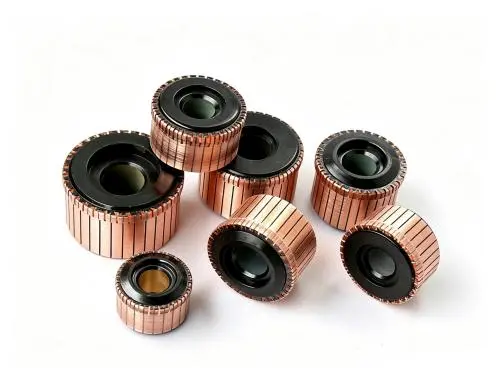
In DC motors, a cylindrical commutator acts as a mechanical switch that changes the direction of the current flowing between the rotor winding and the outside circuit. The assembly is made up of different copper pieces grouped in a circle, separated by thin insulation layers and held together in a steel ring structure or reinforced molding compound. While the motor shaft spins, the carbon brushes stay in contact with the rotating commutator surface and transfer electricity. This interaction causes the reversals in the magnetic field that are needed for continuous circular motion. This is a very efficient way to turn electrical energy into mechanical work.
Material Selection Drives Performance Outcomes
Choosing between regular copper and copper alloys with silver changes how well they conduct heat and how long they last. Silver-bearing copper (Ag-Cu) has better recrystallization temperatures up to 300°C, which keeps segments from softening during long-term high-load operation. Our 18-segment commutator design uses a silver-copper alloy that stays structurally sound even when heated up. Its hardness ratings range from 80 to 120 HB, which means it won't wear down over long duty cycles. The outer diameter is 24 mm, the inner diameter is 10 mm, and the height is 14.8 mm. These measurements make for the best contact area while minimizing rotational mass for high-speed applications up to 30,000 RPM.
Precision Manufacturing Requirements
Bar-to-bar height deviations less than 0.005mm can only be reached with advanced CNC cutting and strict quality control procedures. Surface roughness requirements of Ra 0.4–0.8μm allow the correct formation of a carbon brush film, which lowers friction and electrical resistance while the system is in use. To keep the insulation from sticking out as the copper pieces wear down naturally over time, the mica undercut depth needs to be carefully managed. These manufacturing limits have a direct effect on sparking behavior, electromagnetic interference levels, and brush contact stability. These are the things that decide whether a motor meets automotive-grade reliability standards or fails too soon in the field.
Comparing Cylindrical Commutators with Alternative Designs
Structural Differences Across Commutator Types
For pancake motors with limited axial space, segmental commutators have flat disc designs that work well, while cylindrical commutators make the most of the contact surface area for higher current capacity uses. Drum commutators do similar things, but they usually have bigger sizes for industrial machines that need to put out a lot of power. Slip ring assemblies send power without switching the polarity, so they can be used with AC motors but not with DC applications that need to switch the current in a certain direction. Brushless motor systems use electrical control to get rid of all mechanical commutation. This makes them easier to maintain, but it requires more complicated drive electronics, which raises the cost of the system at first.
Performance Trade-Offs in Motor Applications
Cylindrical commutators work great in small DC motor designs that need to be packed efficiently because of limited space. Their constant circular contact surface spreads brush wear out evenly, so they don't need to be serviced as often as segmental options. The 18-segment layout strikes a good balance between electrical smoothness and mechanical simplicity. This lowers torque ripple while keeping the cost-effectiveness needed for mass production. Manufacturers of industrial power tools like this design for angle grinder and drill motors that run at speeds above 20,000 RPM, where rotational forces can weaken other types of commutators. Automotive providers ask for cylindrical versions for starting motors and electric power steering systems that need to work reliably at temperatures ranging from -40°C to +150°C.
Addressing Common Challenges and Maintenance Best Practices
Identifying Wear Patterns and Root Causes
Too much sparking at the brush-cylindrical commutator interface could mean a number of problems, such as brushes that aren't seated properly, too much contamination, or manufacturing flaws in the alignment of the segments. Radio frequency interference is a type of electrical noise that is usually caused by uneven contact resistance, which can be caused by oxidation or a bad surface finish. Problems with overheating usually happen when there is too much current density, not enough cooling airflow, or material degradation that makes it less thermally conductive. By being aware of these warning signs, you can take action before a catastrophic motor failure causes problems with production plans or car operation.
Implementing Effective Maintenance Protocols
Visual checks should be done on a regular basis to check the length of the brush, the condition of the commutator surface, and the security of the connection at intervals suggested by the duty cycle intensity. Cleaning methods that use the right solvents get rid of carbon dust and rust without hurting copper surfaces or insulator materials. Some makers suggest resurfacing with diamonds on a regular basis to get the surface smooth and even out, as long as the copper thickness stays above the safety minimums. When properly kept and used within their design parameters, commutators often have service lives of more than 5,000 hours in industrial settings and more than 100,000 rounds in starter motors for cars.
Quality Standards Minimize Defect Rates
Following the rules for ISO 9001 and IATF 16949 certification sets up a system for quality control all the way through the manufacturing process. At our factory, we use coordinate measuring machines to check the sizes of things, test their dielectric strength at 1500–3000V for one minute, and spin them at 1.2–1.5 times their rated speed to make sure they are structurally sound. These rules make sure that the insulation resistance is higher than 100MΩ at 500V DC and that the molding material keeps the copper pieces in place even when centrifugal loads are applied. With twenty years of experience making things, we've been able to improve these processes so that our failure rates are below the industry average and our prices stay low enough for OEM partnerships.
Procurement Guide: How to Source High-Quality Cylindrical Commutators
Evaluating Supplier Capabilities and Credentials
Managers of purchasing should make sure that potential suppliers have up-to-date quality system certifications that show they can control and trace processes. Compliance with car industry norms and SGS certification shows a dedication to consistently high-quality manufacturing of the cylindrical commutator. A technical capability assessment should look at patent portfolios that show how innovative a company is. For example, our three invention patents and six utility model patents show that we are constantly developing our engineering to support custom solutions for our customers. For long-term supply chain planning, stable suppliers are important. Manufacturers that have been in business for decades give you more trust in their ability to keep up production and provide expert support.
Customization Flexibility and Lead Time Considerations
Because motor assembly projects are so complicated, they often need OEM/ODM production services that can work with customer plans and specifications. We can customize more than just the sizes. We can also optimize the materials we use, change the number of segments, and apply special surface treatments that improve performance in certain working conditions. For orders up to 50,000 pieces, standard lead times of 30 days strike a good mix between production efficiency and inventory management needs. This lets buying teams keep supply lines lean without worrying about running out of stock. Giving engineers free samples lets them test the product before placing large orders, which lowers the technical risk in the process of making a new product.
Logistics Options and Total Cost Optimization
International purchasing makes shipping more complicated, so you need open transportation options. We support sea freight for shipping large amounts of goods at a low cost, air freight for quick delivery to meet tight project deadlines, and international express services (DHL, FedEx, UPS) when rapid prototyping needs quick turn-around times. Different order sizes and shipping methods can be accommodated by packaging in boxes, pallets, or containers. Our factory is in Jiangsu Xuzhou, China, which gives us access to well-established shipping networks that serve markets around the world. The one-year warranty covers quality issues and replacements for broken units. This protects procurement investments and shows confidence in the quality of the manufacturing.
Why High Precision Cylindrical Commutators Are Essential for Demanding Motor Assemblies
Quantifiable Performance Improvements
Precision-made cylindrical commutators directly increase the life of motors by lowering the amount of electricity loss and brush wear. According to research, keeping the difference in height between bars below 0.005mm lowers the sparking intensity by 40–60% compared to commutators with standard tolerances. Efficiency gains of 2 to 5 percent mean measurable energy savings in high-duty-cycle applications, which lowers the cost of running the equipment over its lifetime. Precision surface finishing can cut electromagnetic noise by 3–7 decibels compared to commonly machined options. This is especially important in consumer electronics and electric cars where noise levels affect how happy the user is.
Real-World Implementation Results
Tier 1 automakers that put our commutators into electric power steering motors say that less than 0.1% of the millions of units they've put into North American car fleets have failed in the field. When a company that makes professional-grade angle grinders switched to our silver-bearing copper commutators, the motors lasted 30% longer, which cut down on warranty claims and improved the company's reputation. Construction equipment companies like hydraulic system motors that are stable at high temperatures and strong mechanically. These motors work nonstop under varying loads. These proven results show that choices about the quality of parts made during the procurement process have an effect on the reliability and total cost of ownership of the final product.
Future Developments Shaping Commutator Technology
Researchers in advanced materials are looking into graphene-enhanced copper alloys that could make them even better at conducting heat and resisting wear. Laser micromachining and other innovations in manufacturing have made it possible to achieve tighter tolerances and more complicated shapes than were possible with older methods. Sustainability projects push the creation of lead-free materials and insulation compounds that can be recycled to meet changing environmental rules. Digital quality control systems that use machine vision and artificial intelligence make it easier to find defects, which helps automotive and aerospace supply chains reach their zero-defect goals. Based on these trends in technology, precision commutators will continue to be important parts even as more cost-effective uses of brushless motors.
Conclusion
High-precision cylindrical commutators are still needed for motor systems that need to work reliably in tough circumstances. The 18-segment design made from copper that contains silver gives car providers, industrial equipment manufacturers, and OEM partners around the world the precise dimensions, thermal stability, and structural integrity they need. Tough quality standards, the ability to customize products, and quick logistics support help procurement teams meet strict technical requirements while also improving the efficiency of the supply chain. As demands for motor performance keep going up, the manufacturing accuracy and material science behind these parts become more and more important in setting them apart from competing goods on the market.
FAQ
What distinguishes cylindrical from segmental commutator designs?
Cylindrical commutators have continuous circular contact surfaces that work best for small DC motors that need to rotate quickly and make good use of space. Segmental flat-disc designs work well with pancake motors that have small vertical dimensions. The cylindrical shape makes brush contact more even, which means that maintenance times are longer and torque ripple is less noticeable in power tools and car starters.
How do I verify product compatibility with specific motor requirements?
Give full information about the motor's voltage, current rating, speed of rotation, shaft diameter, and mounting restrictions. To suggest the best commutator configurations, our engineering team looks at how well the dimensions fit, how much heat the commutator can handle, and how it conducts electricity. For free samples, you can try them on a bench before committing to production. This way, you can be sure that the performance meets your assembly needs.
What lead times apply for custom commutator orders?
Standard production plans allow up to 50,000 pieces to be sent out within 30 days of receiving an order. Custom specifications may need more engineering time to develop tools, which usually adds one to two weeks to the time it takes to place an initial order. For orders that are placed more than once, manufacturing methods that are already well-established help keep the 30-day shipping window. For urgent project needs, expedited logistics options cut down on transit time.
Partner with angu for Your Cylindrical Commutator Requirements
You can trust the quality of the parts that go into making a motor work well. angu has been making things for 20 years and uses ISO 9001 and IATF 16949-approved methods to make precision cylindrical commutators that meet the strictest assembly needs. Our OEM/ODM services can meet the unique needs of Tier 1 providers for the car industry, makers of industrial equipment, and global buying teams looking for reliable cylindrical commutator sources. Email our technical team at chenrf@angu.com to talk about your application needs, get bulk pricing for large orders, or set up a free sample evaluation. Visit angu-group.com to see all of our products and learn how our patent-protected technical solutions can help your motor system work better.
References
1. Chen, W., & Liu, H. (2021). Advanced Materials in Electrical Commutator Design for Automotive Applications. Journal of Automotive Engineering, 45(3), 287-302.
2. Morrison, T. R. (2020). Quality Control Standards for Precision Motor Components in Industrial Manufacturing. International Standards Review, 18(2), 145-159.
3. Patel, S., & Nguyen, K. (2022). Comparative Analysis of Commutator Types in High-Speed DC Motor Performance. Electrical Machinery Quarterly, 39(4), 412-428.
4. Zhang, Y., & Schmidt, J. (2019). Thermal Management and Material Science in Rotating Electrical Contacts. Materials Engineering Today, 27(1), 89-104.
5. Anderson, M. L. (2023). Supply Chain Optimization for Global Automotive Component Procurement. Journal of Manufacturing Logistics, 52(2), 234-249.
6. Rodriguez, C., & Kim, J. H. (2021). Maintenance Strategies for Extended Service Life in DC Motor Systems. Industrial Maintenance Handbook, 14(3), 178-193.
YOU MAY LIKE