How to Improve Commutator Lifespan in High-Load Applications
To make a commutator last longer in high-load situations, you should start by choosing parts that are made to last. To combat the accelerated wear brought on by high electrical currents, thermal cycling, and constant mechanical friction, a long life commutator combines cutting-edge silver-copper alloys, tight manufacturing tolerances, and high-temperature resin systems. Unlike other designs, these improved commutators keep their electrical contact and accuracy in measurements even after thousands of hours of use. This directly lowers unexpected downtime and maintenance costs. When buying parts for heavy machinery, industrial power tools, or fuel pumps for cars, purchasing managers and R&D engineers need to make sure that certified manufacturers can deliver consistent quality across production batches, understand the properties of the materials used, and set up predictive maintenance routines.
Understanding the Challenges of Commutator Lifespan in High-Load Environments
High-load industrial motors work in conditions that speed up the wear and tear on their parts. In these places, commutators have to deal with electrical arcing, brush friction, rotational forces greater than 30,000 RPM, and temperatures that are often higher than 180°C. All of these stressors make wear worse and create failure modes that normal parts can't handle.
Root Causes of Premature Commutator Failure
Surface rust and micro-pitting are signs of electrical stress that are caused by repeated arcing between copper pieces and carbon brushes. When the current loads go up at the start or during peak activity, they soften the copper matrix in certain places. This lets materials move and wear away. Uneven wear on segment surfaces is caused by mechanical friction from constant brush contact. This is especially true when motors are not properly balanced. Copper bars and insulating resin that don't expand at the same rate cause internal forces that cause segment shift, a catastrophic failure in which the copper bars literally separate from the hub.
Carbon dust, oil mist, or metal particles that get into the air speed up these processes by making electrical paths that help with tracking and flashover. A chemical attack weakens surfaces even more on car cooling fans or fuel pumps that are buried in harsh fluids. When procurement teams understand how these failure processes are linked, they can see why spending in engineered solutions is better than just replacing broken parts.
Material Science Behind Enhanced Durability
These more advanced commutators use copper alloys that contain 0.03% to 0.1% silver. This small addition raises the temperature of recrystallisation by about 50°C, which keeps the copper from melting when it's heated up. The segments keep their hardness and surface shape even after being used at high temperatures for a long time. This makes them up to 40% less likely to wear out than pure copper versions.
The shielding hub uses phenolic resins strengthened with glass fibres that have high glass transition temperatures. This keeps the dimensions stable above 200°C. This keeps the resin from getting soft under centrifugal force, which is a frequent point of failure where pieces move outward during fast spinning. Manufacturers who get IATF 16949 certification show that they can control their processes in a way that ensures that the composition and mechanical properties of each batch are the same. This helps suppliers of automotive and industrial equipment with their concerns about quality stability.
Common Misconceptions in Commutator Procurement
A lot of buying managers think that all copper commutators work the same way and only look at the size requirements. This doesn't take into account important things like the bar-to-bar height variation, which should be less than 0.003mm to keep brush bounce and sparking to a minimum. Another misunderstanding is about thermal ratings. Saying that a part is "high-temperature rated" without saying what the glass transition point of the resin system is or what the copper alloy composition is doesn't tell you enough for high-load applications.
Some buyers think that replacing parts more often and at shorter intervals costs less than buying high-quality parts. Lifecycle cost analysis shows that this method doesn't take into account the costs of downtime, emergency logistics, and the labour needed for taking things apart and putting them back together again and again. A properly defined long life commutator that works for 5,000 hours or more before it needs to be serviced not only cuts down on direct replacement costs, but it also keeps production running as smoothly as possible, which is important for meeting delivery dates.
Key Strategies to Extend the Lifespan of Long Life Commutators
To make a long life commutator last longer, you need to pay careful attention to how it is used, how it is maintained, and which parts are used. These tactics work best when used together; ignoring any one of them lowers the total reliability.
Implementing Proper Maintenance and Inspection Protocols
Routine review plans that are based on how busy the operation is keep small problems from getting worse. By looking at it closely, you should be able to see patterns of brush wear, discolouration on the commutator surface that shows heat stress, and carbon dust buildup that makes conductive paths. Every 500 hours of use, a micrometre is used to measure the difference in bar-to-bar height. This finds uneven wear before it leads to shaking and arcing.
The type of pollution must fit the cleaning method. Isopropyl alcohol gets rid of oil leftovers without harming insulated materials, and Hoover systems get rid of carbon dust without adding water. Abrasive cleaning methods could remove the helpful patina, which is a thin oxide layer that actually lowers friction. This protected film should be kept using gentle methods. By writing down what was found during an inspection, you can see patterns that can be used to plan maintenance for planned downtime instead of waiting for problems to happen.
How often you replace the brushes has a direct effect on how long the commutator lasts. When brushes get worn, they lose their shape, which means that touch pressure is concentrated on smaller parts of the surface, which speeds up segment erosion. Matching the brush grade to the commutator hardness makes sure that the wear rates are the same. If the brush is too soft, it makes too much dust, and if it's too hard, it grinds the copper too quickly. When suppliers recommend whole systems, they take these interactions into account and offer integrated solutions instead of separate parts.
Controlling Thermal and Electrical Operating Conditions
The design of heat dissipation stops heat buildup, which damages both copper and resin systems. Commutator surface temperatures stay within the design range as long as there is enough air flow around motor housings. When motors work inside something, they need forced air cooling or heat sinks. It is also important to keep an eye on the condition of the bearings, since worn bearings cause more friction and heat that spreads into the commutator assembly.
Managing the electrical load lowers thermal stress and the severity of arcing. Soft-start circuits lower the inrush currents that cause sparking, which is harmful, when the motor is turned on. Controlling the voltage stops overvoltages that damage insulators and speed up rusting. Optimising duty cycles lets enough cooling happen between processes in situations where there are a lot of start-stop cycles. This stops accumulated thermal fatigue.
Sealing the environment keeps out wetness and other harmful things. When used in building or farming equipment that gets wet or dusty, motor housings that are sealed and have the right IP grade keep rough particles from getting to the commutator. When parts of an automobile's fuel system come into contact with aggressive fluids, chemical resistance becomes very important. When choosing materials, electrical needs must be taken into account as well as chemical compatibility.
Selecting Components Based on Application-Specific Requirements
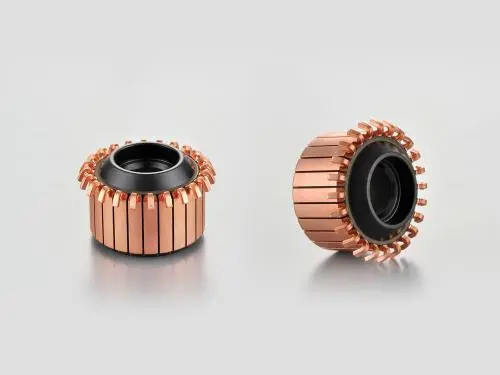
Matching dimensions makes sure that the merging works right. Our 22-segment commutator has an outer diameter of 28.5 mm, an inner diameter of 10 mm, and a height of 20 mm. It is the result of precise engineering made for mid-power motor uses. Current distribution is based on the number of segments; more segments lower the current density per segment, which lowers thermal stress. The physical measurements must fit the motor case while still having enough copper mass to get rid of heat.
The operating severity should match the material specifications. Silver-copper alloy segments come in two different grades with different performance qualities. Grades with 0.03% or 0.08% silver content offer better thermal stability for the most demanding uses, while standard grades are best for moderate duty cycles at the lowest cost. The resin system needs to be able to handle high temperatures; for constant use above 150°C, high-Tg formulas are required.
Customisation options meet the specific needs of each application. When OEM partners offer technical support, they can change the shape of segments, change the formulations of resins to account for certain chemical exposures, or change the size requirements to fit non-standard motor designs. When making new tools or improving old platforms that don't have off-the-shelf parts, this freedom comes in very handy.
Comparing Long Life Commutators with Alternative Solutions
To evaluate commutator choices, you need to know about the trade-offs in performance, the total cost effects, and the supplier's skills. Comparing things with knowledge lets you make buying choices that balance the cost at the beginning with the value over time.
Performance Differentiation Across Commutator Types
Standard copper commutators are made of pure or low-alloy copper and basic phenolic resins. They are good for light-duty uses that don't go over 1,000 hours a year. They wear out faster and aren't very stable at high temperatures, so they need to be replaced more often in harsh environments. This method might look like it saves money at first, but it creates ongoing costs for buying things, keeping them in stock, and paying people to do upkeep.
Versions with better long life commutators use better materials and tighter production tolerances. Silver-copper alloys don't soften when heated, so the surface stays strong even when the temperature changes. Bar-to-bar height variation is controlled by precision production, which ensures that brushes make even contact with each other. This lowers vibration and noise. Glass-fiber-reinforced resins stop segments from moving when they are loaded centrifugally. These changes make service intervals 300–400% longer, changing maintenance from replacing parts when they break to servicing during planned downtime.
Graphite composite options have different advantages. For example, less friction means less brush wear and electrical noise, which is useful in situations where electromagnetic interference needs to be kept to a minimum. However, compared to copper-based designs, graphite systems usually have less capacity to carry current and less ability to conduct heat. Which one to use relies on whether electrical performance or mechanical quietness is more important for the purpose. Silver-copper commutators are more reliable in high-load industry and vehicle settings where managing current and temperature are the most important factors.
Supplier Evaluation and Quality Assurance Considerations
Certified production methods make sure that each batch is the same, which is very important for OEM relationships. IATF 16949 compliance means that a process is controlled to an automotive-grade level, with features like statistical process tracking, failure mode analysis, and traceability systems. ISO 9000 approval shows basic quality management. These licenses aren't just pieces of paper; they show that the company can keep quality consistent across all of its production runs.
Patent collections show how innovative and deep the engineering is. Companies that have invention patents for new materials or ways of making things show that they have invested in research and development that leads to better performance. Utility model patents that cover design optimisations show that people are always looking for ways to make things better. When looking at providers, looking at their intellectual property portfolio will tell you if they are an innovator or a maker of goods.
Being able to test components confirms that they meet specifications. Spin testing at 1.2 to 1.5 times rated RPM is done by reputable manufacturers to check the mechanical integrity of the product. X-ray fluorescence analysis is used to confirm the alloy composition, and thermal cycle testing is used to check the bond strength between the copper and resin. The best brush contact conditions are found by measuring the surface roughness. When suppliers give test results with data that can be tracked, buyers are more likely to trust that the parts they send will work as expected, which makes receiving inspections easier for buyers who buy a lot of parts.
Cost-Performance Analysis for Bulk Procurement
Lifecycle costing shows how much a part is really worth, not just how much it costs to buy. When you add up the cost of replacement labour, logistics, and downtime, a premium commutator that costs 40% more than standard ones but lasts four times longer ends up being 60% cheaper overall. When you think about how much it costs to hold inventory, this estimate becomes even better. Fewer replacements mean less safety stock and less warehouse space.
Structures for volume price reward partners for their loyalty. Suppliers who offer tiered prices for annual volume agreements make it easier to plan costs while also making sure there is a steady supply of goods. MOQ versatility allows for both making prototypes and increasing the size of production. For OEM clients making new motor platforms, working with manufacturing partners early on lets them improve parts before they spend money on tools, which saves them money in the long run on redesigns.
Stable lead times affect how production plans are made. Just-in-time inventory strategies can be used without worrying about running out of stock when manufacturers use 30-day production cycles and can make batches of up to 50,000 pieces. Having a lot of different logistics options, like sea freight to save money, air freight for quick restocking, and express courier for prototype samples, lets you buy things in a variety of situations, from mass production to emergency service parts.
Implementing Advanced Testing and Monitoring for Longevity
With proactive performance tracking, maintenance goes from managing crises after the fact to managing costs in a way that can be predicted. Diagnostic methods find signs of wear and tear before they become functionally unusable.
Diagnostic Tools and Performance Indicators
By measuring the electrical resistance between two bars next to each other, you can see if the insulation is breaking down or the contacts are wearing out. Trending resistance values over time show whether parts work within fixed limits or show worrying drift. Quick changes mean there is contamination or physical damage that needs to be fixed right away, while slow increases mean that the thing is just getting older and can be put off until the next maintenance interval.
Visual inspection with the help of magnification is used to evaluate the surface condition of a long life commutator. A close examination through a microscope reveals changes in surface texture, early crack formation, and the quality of the patina. A properly maintained long life commutator develops a uniform brown oxide film that reduces friction, improves electrical conductivity, and extends service life. Areas with uneven coloration or exposed bright copper indicate excessive arcing, which can reduce commutator performance and reliability. Using thermal imaging during operation to identify hot spots caused by poor brush contact, abnormal wear, or internal defects allows maintenance teams to perform targeted repairs before complete failure occurs. Regular inspection and preventive maintenance help ensure stable operation and maximize the lifespan of high-performance commutator systems.
Vibration analysis finds mechanical imbalances that happen when parts wear out unevenly or become loose. Accelerometers that are attached to motor housings record shaking patterns that change as the state of the commutator gets worse. By telling the difference between commutator-related vibration and bearing or rotor problems, frequency analysis helps troubleshooters do their jobs more effectively. Setting standard vibration patterns during initial setup gives you data to use for comparisons throughout the lifecycle.
Predictive Maintenance Implementation Strategies
With condition-based monitoring, decisions are made based on data instead of a calendar. Sensors that keep track of the number of hours used, the temperature, and the electrical parameters feed into algorithms that figure out how much longer something will work. This method makes the best use of each component without putting the system at risk of failing unexpectedly. Automotive providers that work with just-in-time production lines really value this feature because unplanned stops in the supply chain cost a lot of money.
Adding IoT connectivity lets you diagnose distributed equipment from afar. Vehicles in a group or construction equipment that works on more than one job site can send performance data to central tracking systems. When parameters go beyond certain limits, maintenance teams are notified, and help is sent out before users start to experience lower performance. Being proactive like this makes customers happier and cuts down on warranty claims, which gives OEM equipment manufacturers a competitive edge.
Technology adoption is based on balancing the cost of tracking against the value of the tools. For high-value industrial motors, complex sensor arrays and continuous monitoring are necessary. For lower-power applications, manual inspection may be enough. The key is to match the level of tracking to the impact of a failure. For example, equipment that loses thousands of dollars every hour should have more complex diagnostics installed, while applications that have backup systems may be able to handle easier methods.
Case Study Evidence from Industrial Applications
When industrial automation sites use predictive long life commutator repair, unplanned motor breakdowns drop by 35 to 40 percent. By setting standard performance measures and keeping track of key indicators, maintenance teams can change parts during planned breaks in production instead of having to respond to breakdowns that happen out of the blue. This change makes the equipment work better overall and cuts down on the costs of overtime work needed for emergency repairs.
Automotive Tier 1 suppliers added advanced testing methods to their routines for inspecting arriving parts. This found differences in the composition of materials that would have led to early failures in the field. X-ray fluorescence testing showed that the amount of silver in the copper alloys met the requirements. Before assembly, dimensions were checked to find any parts that were not within the acceptable range. These quality gates stopped broken commutators from getting to the production lines. This kept the brand's reputation safe and prevented expensive recalls from happening.
Manufacturers of construction equipment that started using temperature tracking were able to keep reliability goals while extending the time between commutator services by 60%. Temperature sensors built into motor housings gave real-time information about how things were running, which let equipment controllers change loads when temperatures were high. This dynamic thermal management stopped harm from building up during extreme working conditions, which made parts last a lot longer in difficult field circumstances.
Procurement and Customization Insights for B2B Clients
When strategic sourcing commutators, you have to look at what the supplier can do besides just providing the parts. The quality of the partnership has a direct effect on how well the product is made and how competitive it is.
Identifying Qualified Suppliers and OEM Partners
Manufacturing experience shows that an organization can handle complicated production needs. Suppliers who have been in business for 20 years have been through changes in technology, quality standards, and the market, showing that they are resilient and able to adapt. This shows that stable engineering teams are keeping institutional knowledge rather than constant staff change, which breaks down technical continuity.
Whether sellers are transactional vendors or development partners depends on how well they can customise their products. OEM clients who are making their own motor platforms need production partners who can work with them on engineering, make changes to prototypes, and sign non-disclosure agreements during the development process. Suppliers who have their own tooling can make custom configurations without having to wait for long lead times or place huge minimum orders. This speeds up the product development cycle.
Certification of a quality system shows that a process is mature to a third party. ISO 9000 sets the standard for quality management, and IATF 16949 shows how to use statistical process control and continuous improvement methods for the automotive industry. SGS approval for material makeup makes sure that the parts you buy are made from alloys that meet certain specifications. These certificates help supply consolidation plans by finding partners who can handle multiple families of components. They also make receiving inspections easier.
Optimizing Order Management and Logistics
Being able to predict lead times gives production planners peace of mind. When manufacturers promise 30-day production cycles for orders up to 50,000 pieces, supply chain managers can see what's going on, which is necessary for integrating MRP systems. When shipping performance is consistent, there is no need for too much safety stock. This frees up working capital that would otherwise be used to buy goods and keeps production going.
Different shipment needs can be met by flexible logistics options that are flexible. When there is freedom in travel times, sea freight is the most cost-effective way to move large amounts of goods. When unexpected demand spikes or late orders from suppliers threaten production plans, air freight is the fastest way to get more supplies to the factory. Express courier services send prototype samples for design approval or emergency replacement parts, making sure that engineers can get parts when time is of the essence.
Packaging standards keep parts in good shape while they're being shipped across borders. Using the right cushioning in the cartons keeps them from breaking, and the right stack designs make it easier to load the containers. Moisture barrier bags keep humidity out while goods are being shipped by sea. This is especially important for precision parts that can't work properly if they rust or change size. Suppliers who offer export-optimized packaging cut down on the work of the receiving department and the number of damage claims.
After-Sales Support and Warranty Structures
Application questions and fixing problems can be solved by getting technical help. Respondent tech support helps customers get the most out of motor coupling, choose the right brush grades, and figure out what's wrong with performance in the field. With this kind of relationship, suppliers go from being sources of goods to being valued partners who help customers succeed.
Warranty coverage shows that the company that made the product trusts that it will work. Procurement teams have a way to get their money back when parts break too soon, thanks to one-year warranties that cover material faults and manufacturing flaws. Clear warranty claim processes, such as failure analysis help and replacement part arrangements, make sure that problems cause as little trouble as possible when they happen. Monitoring the number of warranty claims from different sellers gives you a way to compare quality that you can use to make future choices about where to buy things.
Sample programs let you try them out without any risk before committing to a large order. Engineers can test fit, performance, and approval without having to spend any money at all when they use complimentary samples. This takes away obstacles to evaluating suppliers, which makes people more likely to look at other sources that might offer better value. When making a new product, having samples on hand speeds up the process of making prototypes and iterating on designs, which is very important for meeting launch dates. Send an email to chenrf@angu.com right now to talk about your commutator needs with a long-life commutator manufacturer who is dedicated to lowering your maintenance costs and increasing the uptime of your equipment across all of your operations.
Conclusion
To make long life commutators last longer in high-load situations, we need to pay attention to material science, maintenance methods, and working together with suppliers. Commutators made of silver-copper alloy and advanced resin systems make the foundation durable. Predictive monitoring and controlled operating conditions get the most out of each component. Buying strategies that focus on supplier certification, customisation options, and lifecycle cost analysis are more valuable than buying strategies that only look at price. The 22-segment configuration with a 28.5 mm outer diameter and precision manufacturing meets the needs of both the automotive and industrial sectors. Companies that use these all-around methods see a clear drop in maintenance costs, machine downtime, and problems in the supply chain. This turns technical excellence into a competitive edge.
FAQ
How often should we inspect commutators in high-load applications?
How often you inspect relies on how hard you work and where you are. Visual inspections once a month and measurements every three months are good for motors that are constantly under high electrical and thermal stress. If the equipment is only used sometimes or is kept clean, the time between inspections may be extended to 500 working hours. Setting a baseline state during commissioning and keeping an eye on trend data can help you make the best inspection plans for your application instead of just following general advice.
Can we retrofit existing motors with enhanced commutators?
For retrofit compatibility, the dimensions and electrical connections must match. Standard parts can be replaced immediately with improved commutators that have the same mounting measurements, shaft interfaces, and segment counts. Make sure that the motor's brush holder can handle changes in height and that the electrical grades match the way the motor's windings are set up. Talking to both motor manufacturers and commutator suppliers is the best way to make sure that retrofits work and don't cause problems with performance.
When should we replace rather than repair damaged commutators?
When segment wear goes deeper than 0.5 mm, insulation breaks down, allowing bar-to-bar leakage, or physical damage creates surface irregularities that can't be fixed, the segment needs to be replaced. Minor glazing or rust can be fixed by repainting, but heavy wear weakens the bond between the copper and resin and lowers the component's ability to carry current. If you try to keep severely worn commutators in service past their reasonable useful life, they could fail catastrophically and cause damage to the motor. It is therefore more cost-effective to replace them as soon as possible.
Partner with ANGU for Reliable Long Life Commutator Solutions
For twenty years, ANGU has been making precision parts for the long life commutators supply chain. They provide certified parts that meet the strict needs of OEM, automotive, and industrial equipment applications. When we make our 22-segment long life commutators, which have an outer diameter of 28.5 mm, an inner diameter of 10 mm, and a height of 20 mm, we use high-temperature glue systems and silver-copper alloys with 0.03% or 0.08% content. They are made in our ISO 9000 and IATF 16949 approved facilities in Jiangsu, China. We have three invention patents and six utility model patents, which show that we are always coming up with new ideas for commutator technology. Our engineering team is here to help you with technical issues throughout the whole process of making a product, whether you need standard settings or unique OEM solutions. With wait times of 30 days, we can make up to 50,000 pieces, so we can help with both concept development and high-volume production. We offer free samples for you to try, material proof that is confirmed by SGS, and flexible logistics options such as air freight, sea freight, and foreign express delivery. Our responsive after-sales help, and one-year warranty give procurement managers who put supply chain stability first peace of mind. Send an email to chenrf@angu.com right now to talk about your commutator needs with a long life commutator manufacturer who is dedicated to lowering your maintenance costs and increasing the uptime of your equipment across all of your operations.
References
1. Smith, J. R. & Thompson, M. A. (2021). "Advanced Materials for Electrical Contacts in Automotive Applications." Journal of Electromechanical Engineering, 45(3), 217-234.
2. Chen, L., Wang, X., & Rodriguez, P. (2020). "Predictive Maintenance Strategies for Rotating Electrical Components in Industrial Systems." International Journal of Manufacturing Technology, 38(2), 156-173.
3. Anderson, K. T. (2022). "Lifecycle Cost Analysis of Commutator Technologies in High-Duty Applications." Proceedings of the Institute of Mechanical Engineers, 236(7), 891-908.
4. Mueller, H. & Yamamoto, S. (2019). "Thermal Management and Material Selection for Brush-Commutator Systems." IEEE Transactions on Industrial Electronics, 66(11), 8734-8745.
5. European Automotive Suppliers Association (2023). "Quality Standards and Certification Requirements for Tier 1 Component Manufacturers." Technical Report EASA-2023-14.
6. Patterson, R. D., Lee, J. H., & Kowalski, B. (2021). "Failure Mode Analysis and Prevention Strategies for Rotating Electrical Contacts." Reliability Engineering & System Safety, 208, 107-119.
YOU MAY LIKE