Magnet for motor rotor guide to types performance comparison
Picking the correct magnet for motor rotor uses has a direct effect on how well they work, how long they last, and how much they cost to make. Because of how fierce the market is now, motor makers are under more and more pressure to meet strict standards like IATF 16949 while also sticking to tight budgets and making sure the supply chain stays stable. This detailed guide explains the main kinds of rotor magnets, compares how well they work, and gives useful advice for purchasing managers, research and development engineers, and quality managers who want to make motor designs better. Knowing the differences between neodymium, ferrite, and other specialized magnet materials helps you make smart buying choices that balance cost-effectiveness with technical ability.
Understanding Motor Rotor Magnets: Basics and Functionality
What is a Magnet for a motor rotor?
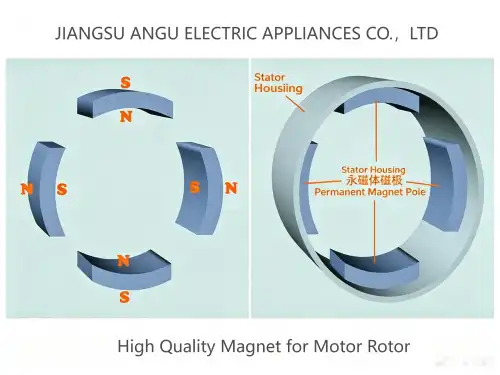
A magnet for motor rotor is a strong permanent magnet that is built into the moving part of an electric motor. Its job is to create a steady magnetic field that reacts with the stator windings to create power through electromagnetic induction. These magnets, which are usually made of Neodymium Iron Boron (NdFeB), Samarium Cobalt (SmCo), or Ferrite, don't need rotor windings or slip rings, so they are simpler to build and lose less energy. In current industry settings, rotor magnets solve important problems like making too much heat, the need for extreme miniaturization in robotics and aerospace, and the need for better energy economy in line with IE4 and IE5 standards.
How Rotor Magnets Enhance Motor Performance
There are three main ways that rotor magnets affect how well a motor works. They make a steady magnetic flow that affects torque density directly. This lets small motor designs produce power levels that would normally need bigger induction motors. Overall efficiency goes up a lot when there are no rotor copper losses. This lowers running costs in continuous-duty use. Magnets that are carefully made and have tight geometric limits (often within +/-0.05mm) keep the rotor in balance, which reduces shaking and increases the bearing's life.
The magnet for motor rotor performance depends heavily on the choice of magnetic material. High-energy neodymium magnets allow for the highest power density, which is very important for electric car traction motors that can work at up to 20,000 RPM. Their great efficiency is due to their high remanence (Br) values, which range from 1.1T to 1.48T, and their highest energy product (BHmax), which can reach 52 MGOe. Having a basic understanding of these concepts helps buying teams decide if the technical specs of a magnet match the needs and conditions of their motor.
Types of Motor Rotor Magnets and Their Key Properties
Neodymium (NdFeB) Magnets
Neodymium (NdFeB) magnets are the strongest permanent magnets that can be bought, which is why they are the best choice for high-performance motor uses. Their high magnetic strength comes from remanence values above 1.4T in top grades. This means that they can be used to make small rotors that produce a lot of power. When properly graded, these magnets keep working well at a lot of different temperatures. Specialized high-temperature versions (UH and EH grades) can work well up to 200°C.
High-quality neodymium rotor magnets usually have an intrinsic coercivity (Hcj) that is higher than 25kOe. This is important because it keeps the magnets from losing their magnetic field during high-temperature and peak current loads. Grain Boundary Diffusion (GBD) technology and other advanced production methods improve coercivity without lowering magnetic strength, achieving the best balance between performance and cost. Surface treatments like multi-layer Ni-Cu-Ni, epoxy, or specialized coats keep metals from oxidizing and getting damaged by chemicals, which increases their useful life in harsh industrial settings.
Ferrite Magnets
Ferrite magnets are a cheap option for situations where budget concerns are greater than the need for maximum power output. These magnets are made of ceramics that contain iron oxide and barium or strontium carbonate. They are very stable at high temperatures and don't rust, so they don't need any extra coats to protect them. Due to their lower magnetic strength compared to rare-earth magnets, their rotors need to be bigger to produce the same amount of power. However, this trade-off is fine for many industrial motor, pump, and fan uses.
Ferrite magnets used as a magnet for motor rotor are naturally fragile, so they need to be handled carefully when they are being put together. However, they are reliable for continuous-duty cycles because they don't lose their magnetic properties when they are heated up. Even when heated to 250°C, ferrite materials keep working the same way, which is better than normal neodymium grades. Their stable prices and wide availability protect supply lines from the changes in the market that affect rare-earth elements, making them appealing to procurement managers who want to know what the costs will be in the long run.
Samarium Cobalt and Specialized Magnets
Samarium Cobalt (SmCo) magnets are very expensive because they have to be able to withstand very high temperatures and be very stable. They work successfully up to 350°C and are used in high-temperature industrial, military, and aerospace uses where neodymium magnets would fail. Their high resistance to corrosion means that safe coatings are not needed, and their high thermal stability means that their magnetic properties stay the same even when the temperature changes.
Bonded and composite magnets let you create complicated rotor shapes that you can't do with sintered magnet segments. These magnets are made of magnetic powder and polymer binders. They can be shaped into complex shapes using injection molding or compression. Even though bonded magnets aren't as magnetically strong as sintered neodymium, they make manufacturing simpler in some motor designs and allow combined magnetic circuits that make assembly easier.
Neodymium vs. Ferrite Magnets for Motor Rotors: A Detailed Comparison
Magnetic Performance and Motor Efficiency
Magnet for motor rotor applications show that neodymium and ferrite magnets have different performance profiles that make them better for different types of applications. Neodymium magnets have three to four times the magnetic energy density of ferrite magnets. This lets motor designers make motors with more power that fit in a lot less space. This benefit is very important for electric car motors, where limited room and lighter weight directly affect the range and performance of the vehicle. The higher flux density means that motors are more efficient, which helps makers meet the strict IE4 and IE5 standards that are required in many markets.
Even though ferrite magnets aren't as strong as permanent magnets, they work well enough for cost-sensitive tasks where motor size isn't as important. Their stable magnetic qualities over a wide range of temperatures make sure that motors in HVAC compressors, commercial fans, and home appliances always work right. In low-speed situations where mechanical losses are more common, the efficiency gap gets smaller. This makes ferrite a cheap choice for large production runs.
Temperature Resistance and Durability
Temperature performance is an important factor to consider when choosing rotor magnets that will work in settings with high temperatures. Standard types of neodymium keep their full magnetic strength up to 80°C. Specialized high-temperature versions can work at up to 200°C by adding dysprosium and terbium in a controlled way. Ferrite magnets are better at withstanding high temperatures; their magnetic properties don't change up to 250°C. However, because their base strength is smaller, they need bigger magnet sizes.
Quality magnet suppliers can be told apart by their demagnetization resistance under load. Peak motor currents during start-up or overload conditions make strong demagnetizing fields that can forever weaken magnets that aren't strong enough. Neodymium magnets with a high coercivity that have been handled with GBD technology don't lose their magnetic properties even when there are great electrical changes. This keeps the motor working well for a long time. The people in charge of buying things need to make sure that the magnet specs include enough safety margins for the worst possible working conditions.
Cost Considerations and Supply Chain Factors
In addition to the price of raw materials, total cost analysis for a Magnet for motor rotor looks at how efficiently a product is made, how reliable its supply chain is, and how much it costs over its whole life. Neodymium magnets are more expensive because they contain rare-earth elements and are harder to make. However, their higher power density often lowers the overall cost of motor materials by allowing smaller stator cores, less copper wiring, and smaller housings. Large producers can get reasonable prices on neodymium by taking advantage of volume discounts and long-term supply agreements.
The prices of ferrite magnets are steady and don't change based on global events that affect the rare-earth market. Their large supply of raw materials and well-established production facilities make their supply chains stable and their lead times short. This makes them appealing to buying strategies that put supply security over maximum performance. To figure out the total cost of ownership, you have to add up the expected product lifetime, the amount of energy saved by making the product more efficient, and the cost of upkeep.
How to Select and Purchase the Right Motor Rotor Magnets
Defining Technical Requirements
Magnet for motor rotor: To buy a magnet successfully, you need to start with technical specifications that are clearly defined and aligned with the performance targets and operating conditions of the motor. Key factors include the required magnetic flux density at critical rotor positions, the maximum operating temperature with appropriate safety margins, the allowable level of demagnetization under fault conditions, and the geometric constraints imposed by the rotor structure. Rather than using vague descriptions, engineering teams should express these requirements in measurable parameters, enabling suppliers to develop optimal and precise solutions.
The exact measurements of our normal output magnet segments are as follows: the outer arc radius is R36 (+0.2/-0.1) mm, the inner arc radius is R28.3 (+0.3/0) mm, the radial height is 22 (+0/-0.4) mm, and the thickness is 7.6 (+0/-0.2) mm. The length is 62 ±1 mm, and the width is 50 (+0/-1) mm. The angle is 90° ±2°, which makes it ideal for electric car motors, industrial motors, e-bike applications, and generator rotors. These close limits make sure that the rotor is always balanced and that the magnetic field is spread out evenly.
Custom vs. Standard Magnet Solutions
Standard magnet shapes shorten the time it takes to build new products and lower the cost of making tools for motor designs that use known magnet sizes. A lot of suppliers keep popular rotor magnet shapes in stock, which lets you make prototypes quickly and cut down on lead times for first production runs. Standard magnets work well in situations where the motor design can change to fit different magnet sizes without affecting performance goals.
When motor specs call for special shapes, coatings, or magnetic properties, custom magnet making opens up chances to improve the design. We can fully customize OEM/ODM orders based on customer examples or sketches. This includes choosing the performance grade, custom measurements, and tolerances. Our post-processing services include different types of surface coatings (Ni-Cu-Ni, epoxy, and zinc), magnetization patterns, and quality testing methods. Standard samples are sent out within 10–15 days, and large custom orders are finished within 35–40 days. Our production methods are ISO 9000 and IATF 16949 approved to help with this.
Supplier Evaluation and Quality Assurance
Tough screening of suppliers keeps quality problems from spreading and causing expensive motor breakdowns and guarantee claims. Manufacturing certifications like ISO 9000 for general quality management and IATF 16949 for car use should be checked by procurement teams. This is to make sure that sellers keep written process controls and traceability. Asking for third-party test results, like RoHS compliance and SGS material certifications, proves that the specs and environmental standards being claimed are correct.
Beyond basic manufacturing skills, technical powers set providers apart. With 20 years of experience in producing Magnet for motor rotor products, we hold 3 invention patents and 6 utility model patents covering advanced magnet processing methods, allowing us to meet even the most demanding requirements. Engineering support services help customers choose the best magnets for their motor designs, which could save costs by optimizing material grades or magnet shapes. Different levels of urgency and inventory management strategies can be supported through various logistics options, including sea freight, air freight, and express courier services such as DHL, FedEx, and UPS.
Optimizing Motor Efficiency Through Magnet Choice and Maintenance
Advanced Magnetization Techniques
Besides the qualities of the raw magnet material, the right magnetization patterns have a huge effect on how well a motor works. For rotors that are fixed on the outside, diagonal magnetization patterns work best. For permanent magnet motors that are inside, radial or multipole patterns work best for distributing flux. We use precise magnetization tools that can create regular fields that fully saturate magnet material. This makes sure that all production batches have the same pole strength and maximum remanence.
Magnet for motor rotor segmented rotor magnets reduce eddy current losses by blocking current paths inside the active magnetic material during high-frequency operation. This design is especially effective for motors operating above 10,000 RPM, where eddy current heating can significantly impact efficiency and accelerate magnet demagnetization. Our production capabilities enable us to manufacture matched magnet sets with excellent magnetic balance and high geometric precision. As a result, rotor assemblies can achieve G2.5 or better balance grades, ensuring extremely low vibration during high-speed operation.
Maintenance Strategies for Extended Lifespan
To keep magnets from losing their magnetic field too soon, you need to know what causes operating stress and take precautions. To keep the magnets from getting too hot or too heavy, motor control techniques should limit the amounts and lengths of peak currents. The right design of the cooling system keeps the rotor temperatures below the requirements for magnet grade, especially when the torque level stays high for a long time. Motor testing on a regular basis with back-EMF readings or magnetic flux sensors can find early signs of wear and tear, allowing repair to be done before performance drops significantly.
When cleaning solvents, coolants, or process fluids come in touch with rotor parts in the workplace, they can be exposed to chemicals. Our special coatings, like epoxy and Everlube, keep magnets safe from industrial oils and chemical cleaners, which makes them last longer in tough conditions. Using moisture-proof and shock-proof cases for shipping and storage is the best way to keep motors from getting damaged during handling and rusting before they are put together.
Real-World Performance Improvements
Magnet for motor rotor premium magnet selection has been shown to give real returns on investment in case studies. When a car provider switched from standard-grade to high-temperature neodymium magnets in their traction motor, it became 4% more efficient across the drive cycle. This improvement meant that electric vehicles could travel farther on a single charge. In addition, the motor’s lower operating temperature reduced the demand for thermal management, and the resulting system-level savings outweighed the additional cost of the premium magnets.
When an industrial pump maker switched from ferrite to neodymium rotor magnets, the motor frame size was cut by two standards without affecting the hydraulic performance. The small motor installation made it easier to build the pump housing, cut the weight of the whole product by 18%, and raised the energy efficiency scores. These real benefits show how smart magnet choice affects the success of a product as a whole, not just by comparing the costs of individual parts.
Conclusion
To choose the right magnet for motor rotor uses, you have to balance scientific performance, cost, and the reliability of the supply chain. Neodymium magnets have the highest power density for high-performance uses that need to be small and light. Ferrite magnets, on the other hand, are more cost-effective for less demanding settings. Knowing important features like magnetic strength, temperature resistance, and coercivity helps you make smart buying choices that meet the needs of your motor. Quality risks that hurt the reliability and longevity of motors can be avoided by carefully checking suppliers' quality certifications, technical support skills, and manufacturing experience.
FAQ
Which magnet type suits high-temperature motor applications?
Samarium Cobalt (SmCo) magnets can withstand temperatures as high as 350°C, which makes them perfect for places with very high or very low temperatures. High-temperature neodymium grades (UH, EH) can safely work up to 200°C if they are properly defined and have enough coercivity margins. Ferrite magnets are less expensive and have better temperature stability up to 250°C, but they need bigger spaces because they aren't as strong magnetically.
How can I verify magnet quality from new suppliers?
Ask for test results from a third party that include measures of the magnetic properties (Br, Hcj, BHmax), certificates of dimensional inspection, and a study of the material's makeup. When you ask, our production comes with RoHS and SGS approval paperwork. Independent testing of prototype samples is possible before placing bulk orders, confirming that the claimed specs match the real performance.
What are the environmental considerations for neodymium magnets?
Neodymium magnets contain rare-earth elements that need to be sourced responsibly and recycled when they are no longer useful. A lot of companies now take part in closed-loop recycling programs that get useful materials from old motors. Proper disposal through approved recycling pathways keeps the environment clean and supports the circular economy principles that are being required more and more in programs for sustainable industrial manufacturing.
Partner with Angu for Reliable Magnet for Motor Rotor Solutions
At angu, we know how important precision magnets are to the performance of your motor and the economy of your output. Our factory is ISO 9000 and IATF 16949 approved, and it uses 20 years of technical know-how and patent-protected new ideas to make motor rotor magnets that are exactly what you need. We promise accurate measurements, uniform magnetic properties, and on-time 30-day delivery on all standard segments that use our tried-and-true R36 outer arc geometry or fully custom OEM solutions based on your plans.
Our full range of services includes flexible shipping choices by sea, air, or express carriers, low prices for bulk purchases, and a full 1-year guarantee that covers quality issues with replacement support. You can talk to an expert magnet for motor rotor provider who knows how to meet the needs of automotive, industrial equipment, and electric vehicle uses by emailing our technical team at chenrf@angu.com. Let us help you get the most out of your motors while making your global supply chain easier to manage.
References
1. Jahns, T.M. & Sarlioglu, B. (2021). Permanent Magnet Synchronous Machines: Design and Performance Analysis. Cambridge Engineering Press.
2. Campbell, P. (2019). Principles of Electric Motor Design and Material Selection for Automotive Applications. SAE International Publications.
3. Liu, H. & Zhang, Y. (2020). "Comparative Study of NdFeB and Ferrite Magnets in Industrial Motor Efficiency." Journal of Magnetic Materials and Engineering, 45(3), 234-251.
4. International Electrotechnical Commission (2022). IEC 60034-30-1: Rotating Electrical Machines - Part 30-1: Efficiency Classes of Line Operated AC Motors. IEC Standards.
5. Gutfleisch, O. et al. (2020). "Advanced Rare-Earth Permanent Magnets: Manufacturing Processes and Sustainability Considerations." Materials Science and Technology Review, 28(7), 1142-1168.
6. Automotive Industry Action Group (2023). IATF 16949:2016 Quality Management System Requirements for Automotive Production and Relevant Service Parts Organizations. AIAG Reference Manual.
YOU MAY LIKE