Precision Motor Magnet Segment for High-Efficiency Electric Motors
Precision motor magnet segments are unique permanent magnet parts that were made with perfect arc shapes to improve the performance of electric motors. These segments are made from high-quality sintered Neodymium Iron Boron (NdFeB). They have a higher magnetic flux density and better dimensional accuracy, which solves important problems like cogging torque and energy loss. Their accuracy down to the micron level makes it possible for brushless DC motors, power tools, and electric car traction systems to achieve high power densities, lower noise levels, and higher efficiency. This makes them essential for procurement managers looking for reliable, high-performance motor options.
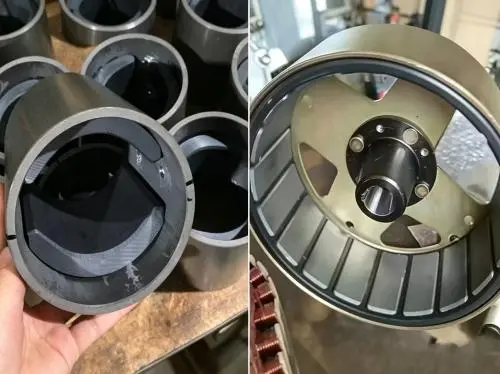
Understanding Precision Motor Magnets: Core Engineering Principles
Precision motor magnet segments change the way rotor assemblies work by distributing the magnetic field in a controlled way. Unlike regular magnets, these parts go through advanced sintering processes that make crystalline structures that are best for aligning magnets. Radial magnetisation, in which the magnetic field spreads out perpendicular to the arc surface, ensures that the force is generated evenly during all spinning cycles.
Material Science Behind High-Performance Magnets
We've seen how the choice of material has a big effect on how well a motor works. Neodymium Iron Boron magnets are the most popular because they have the highest energy output ((BH)max values over 35 MGOe) of all the materials that are offered on the market. The grades in the CY35, CY36, and CY37 series are the right mix of magnetic strength and thermal stability. Depending on the grade, they can keep working well at temperatures up to 120°C to 150°C. During sintering, precise oxygen control is used on these metals to stop oxidation that would weaken their magnetic qualities over 10–15 years of use in industrial settings.
Geometric Precision and Its Impact on Motor Performance
The outer radius of the segments ranges from 27.56 mm to 27.71 mm, and the inner radius ranges from 21.10 mm to 21.25 mm. These sizes show technical tolerances that are important for rotor balance. Radial width changes of 6.00 to 6.40 mm allow for thermal growth during high-speed running while keeping the air gap sizes the same. The axial length of 50–52.50 mm and chord width of 44.20–46.40 mm are chosen so that magnetic flux leakage at segment interfaces is kept to a minimum. End angles between 7.0° and 13.0° let designers find the best designs for pole counts. This directly affects the torque ripple characteristics that procurement teams look for in applications that can't handle vibration, like medical equipment drives or precision robots.
Application Scope Across Industrial Sectors
Real-life examples of rollout show how flexible it is. Electric car traction motors benefit from high remanence (Br up to 1.45T), which speeds up the vehicle while reducing battery drain. Precision placing within micrometres is achieved by industrial servo systems in automatic assembly lines that work with narrow tolerance ranges (±0.1 to ±0.5 mm). E-bike hub motors use these segments to cut down on weight without sacrificing torque for climbing hills, and generator rotors in wind turbines use their temperature stability to convert energy consistently even when temperatures change with the seasons.
Comparing Precision Segments to Standard Motor Magnets
When procurement managers look at magnet choices, they have to choose between cost and efficiency. Standard bonded magnets have lower unit costs, but they can only provide 60–70% of the magnetic flux density that can be achieved with precision motor magnet segments. This difference in performance directly leads to motor efficiency losses of 8–12% in BLDC motors, which cancel out any savings at first by using more energy over the life of the product.
Why Brushless Motors Demand Precision Segments
Because brushless DC motors don't have mechanical commutators, they need the magnetic field to be more regular. Precision segments made according to IATF 16949 standards have flux variations of less than ±2% across their surfaces. This makes sure that electronic processors can handle smooth commutation changes. This consistency cuts electromagnetic noise by 15–20 dB compared to regular magnets. This helps with quality issues in car cabins where NVH (noise, vibration, and harshness) standards are strict.
Temperature Stability and Coercivity Considerations
Grade selection is based on the operating environment. At 100°C, the CY35 series keeps 90% of its magnetic properties at room temperature, making it a good choice for power tool motors that are subject to intermittent thermal loads. For continuous-duty commercial motors, CY37 types raise this temperature range to 120°C. When intrinsic coercivity (Hcj) values are higher than 35 kOe, demagnetisation doesn't happen. This is important for generator rotors that are exposed to fault current spikes because external magnetic fields or armature reaction could weaken the magnet over time.
Procurement Strategies for Magnet Segments
To get around in the global supply system, you need to know how to check quality and when to start production. Standard sample production usually takes 10-15 days, which gives engineering teams time to check fitment and magnetic performance before committing to bulk orders. Full production runs take 35–40 days, which includes the time it takes for the sintering cycle and any post-processing steps, such as applying a Ni-Cu-Ni triple-layer covering that is resistant to salt spray for more than 96 hours, as required by ASTM B117.
Customization Capabilities and OEM/ODM Services
Today’s procurement requirements involve much more than simply following catalogue specifications. When OEM partners provide Precision motor magnet segment customization support, they can modify segment geometry based on CAD models and adjust chord width in 0.5 mm increments to match different stator slot configurations. Advanced Precision motor magnet segment solutions offer more surface coating options beyond standard nickel plating. For example, epoxy resin coatings provide improved moisture resistance for marine and naval applications, while phosphate coatings enhance bonding performance in assembled rotor units. Customers can also select magnetization angles with accuracy within 0.5°, which is essential for reducing cogging torque and improving motor efficiency in high-pole-count designs, such as elevator traction motors and other precision electric drive systems. These customization capabilities help optimize magnetic performance, durability, and reliability for demanding industrial applications.
Quality Certification and Third-Party Testing
By checking certifications, procurement managers lower the risk in the supply chain. Compliance with ISO 9000 and IATF 16949 shows that you can control the production process, and RoHS and REACH standards show that your materials are safe for use in European markets. A third-party SGS report verifies the magnetic properties using Helmholtz coil measures, and the correctness of the dimensions using a coordinate measuring machine (CMM) check. Tests with salt spray (96–240 hours) and pressure cookers (PCT) at 121°C and 2 atmospheres of pressure mimic fast ageing and suggest a 15-year service life in normal industry conditions.
Manufacturing Precision and Quality Control Protocols
The first step in making something is making an alloy. The amounts of neodymium, iron, and boron are carefully controlled to within 0.1%. When thin bands are made by strip casting, they go through hydrogen decrepitation, which breaks ingots into powder particles 3–5 microns in size. These particles are small enough to form single-domain crystals during sintering. Before the particles are orientated in 15–20 kOe magnetic fields and pressed into green compacts at 100–150 MPa, oxidation is stopped by jet milling in a neutral atmosphere.
Sintering and Heat Treatment Cycles
Vacuum sintering at 1050–1080°C for 4–6 hours makes the material denser and more compact, reaching up to 99% of its theoretical density for a high-performance Precision motor magnet segment. This process also forms the Nd₂Fe₁₄B crystalline phase, which provides the strong magnetic properties required for advanced motor applications. Controlled cooling rates prevent cracks from developing in arc-shaped designs, where temperature differences can create internal mechanical stress and affect the reliability of the Precision motor magnet segment. After sintering, heat treatment at 500–600°C improves coercivity by forming thin grain boundary phases that separate magnetic domains, increasing resistance to magnetic demagnetization and enhancing the long-term stability, durability, and performance of precision magnetic components used in electric motors.
Precision Grinding and Tolerance Achievement
To get ±0.1 mm tolerances on curved surfaces, diamond grinding wheels need to be running at 2000–3000 RPM with cooling systems to keep the wheels from getting damaged by heat. When CNC grinding centers have in-process gauging, they change the tool paths in real time to account for wheel wear. The radial thickness uniformity has a direct effect on the dynamic balance of the rotor. Deviations of more than 0.05 mm between opposing segments can cause vibrations that can be felt at 10,000 RPM.
Magnetic Property Verification and Field Mapping
Quality assurance is more than just checking the sizes. Helmholtz coil systems measure magnetic moment with an accuracy of ±1%, which proves grade conformance. Gauss meter mapping across segment surfaces finds changes in flux density and throws out parts with deviations greater than 3%. In thermal demagnetisation testing, samples are heated to 150°C for two hours to make sure that flux loss stays below 5%, which is a level that ensures long-term stability in motor uses that cycle between room temperature and high temperatures.
Future Innovations Shaping Motor Magnet Technology
New developments in material science aim to reduce the use of rare earths without affecting performance. Researchers studying grain boundary diffusion processes add dysprosium or terbium only to the surfaces of crystals. This lowers the heavy rare earth content by 30–40% while keeping the high-temperature coercivity. This method fixes problems in the supply chain that are caused by the lack of rare earth elements. This is especially important as the world's production of electric cars grows and reaches 30 million units per year by 2030.
Additive Manufacturing and Near-Net-Shape Production
New 3D printing methods that use magnetic powder as a feedstock offer physical freedom that can't be achieved with traditional pressing methods. Selective laser sintering could make cooling lines built into rotor segments, which would make high-power-density motors better at managing heat. At the moment, additive methods can only match the performance of traditionally sintered magnets by 85–90%. However, this gap may be closed within 3–5 years as binder systems and post-processing protocols continue to be improved.
Sustainability and Circular Economy Initiatives
Recycling technology is always getting better because of concerns about the environment. Hydrometallurgical methods can get neodymium from old motors and make it 95% pure enough to be used again in magnet production. Leading manufacturers are setting up closed-loop systems where waste from the manufacturing process goes straight back into the alloy formulation stages. This cuts down on the cost of raw materials by 10–15% and leaves less of an impact on the environment, which is becoming an increasingly important factor for procurement teams trying to meet corporate sustainability goals.
Conclusion
To choose the right Precision motor magnet segment, you need to balance technical requirements with supply chain reliability. Because a Precision motor magnet segment features radial magnetization, tight dimensional specifications, and customized size options, these components play an essential role in improving motor efficiency, magnetic performance, and overall system reliability. With 20 years of manufacturing experience and IATF 16949 certification supporting consistent production quality, procurement managers can confidently specify these magnetic segments knowing they will meet performance expectations. The 30-day delivery commitment, combined with flexible logistics options such as sea freight for cost efficiency or air express for urgent prototyping requirements, helps address different timelines for new product development and mass production. As motor technologies continue to advance toward higher power density, lower heat generation, and improved energy efficiency, the precise engineering of Precision motor magnet segment products will remain critical for maintaining competitiveness in electric vehicle, renewable energy, and industrial automation markets.
FAQ
What temperature grade should we specify for continuous-duty industrial motors?
Motors that run continuously at temperatures above 100°C need grades CY36 or CY37, which are more thermally stable. The higher intrinsic coercivity stops flux loss that can't be undone during prolonged thermal exposure. This keeps torque output constant over the 10,000-hour operating lives that are common for industrial pump and compressor applications.
How does segmenting the rotor magnet reduce eddy current losses?
By separating the magnetic ring into separate pieces, the electrical resistance in the circular direction goes up. This makes it harder for eddy current paths caused by stator field harmonics to travel. This division cuts core losses by 20–30% at frequencies above 500 Hz, which makes high-speed motor uses like spindle drives and turbo-compressors more efficient.
Can custom tolerances tighter than ±0.1 mm be achieved?
Tolerances of ±0.05 mm can be reached with ultra-precision grinding, but it takes more time and special tools to do so. For direct-drive uses, the rotor imbalance must stay below 0.5 gram-millimeters to keep the bearings from wearing out at speeds of 15,000 RPM or more.
Partner with Angu for Precision Motor Magnet Solutions
Angu has been making magnets well for 20 years and can help you with your motor design problems. As a certified supplier with ISO 9000 and IATF 16949 credentials, we offer Precision motor magnet segments that are engineered to meet exact specifications. This includes choosing the right grade (CY35, CY36, or CY37) and applying a protective coating and radial magnetisation. Our OEM/ODM services allow us to make custom sizes based on your plans. Samples can be made in 10–15 days, and large orders can be delivered in 35–40 days. Every piece is carefully checked with a CMM, and its magnetic properties are confirmed. This is backed up by RoHS and SGS certifications from outside sources. We help with foreign logistics by offering services like plane express, sea freight, and DHL/FedEx. This will keep your production schedule on track. If you have problems with the quality, our 1-year warranty lets you return or get a new product. Contact our procurement specialists at chenrf@angu.com to discuss your requirements and receive tailored quotations. Angu is ready to be your go-to maker of Precision motor magnet segments, whether you need them for traction motors in electric vehicles, industrial servo systems, or power tool uses.
References
1. Gutfleisch, O., et al. "Magnetic Materials and Devices for the 21st Century: Stronger, Lighter, and More Energy Efficient." Advanced Materials, vol. 23, 2011, pp. 821-842.
2. Hendershot, J.R., and Miller, T.J.E. Design of Brushless Permanent Magnet Machines. Motor Design Books LLC, 2010.
3. Brown, D., Ma, B.M., and Chen, Z. "Developments in the Processing and Properties of NdFeB-Type Permanent Magnets." Journal of Magnetism and Magnetic Materials, vol. 248, 2002, pp. 432-440.
4. Cui, J., et al. "Current Progress and Future Challenges in Rare-Earth-Free Permanent Magnets." Acta Materialia, vol. 158, 2018, pp. 118-137.
5. Jahns, T.M., and Soong, W.L. "Pulsating Torque Minimization Techniques for Permanent Magnet AC Motor Drives." IEEE Transactions on Industrial Electronics, vol. 43, 1996, pp. 321-330.
6. Binnemans, K., et al. "Recycling of Rare Earths: A Critical Review." Journal of Cleaner Production, vol. 51, 2013, pp. 1-22.
YOU MAY LIKE